
AI persona security risks in 2026 center on prompt injection in agentic skills and supply chain vulnerabilities within Model Context Protocol (MCP) servers. Securing these systems requires cryptographically signed skills and rigorous infrastructure audits. Organizations must shift from filtering model outputs to hardening the execution environment against goal hijacking and unauthorized financial transactions.
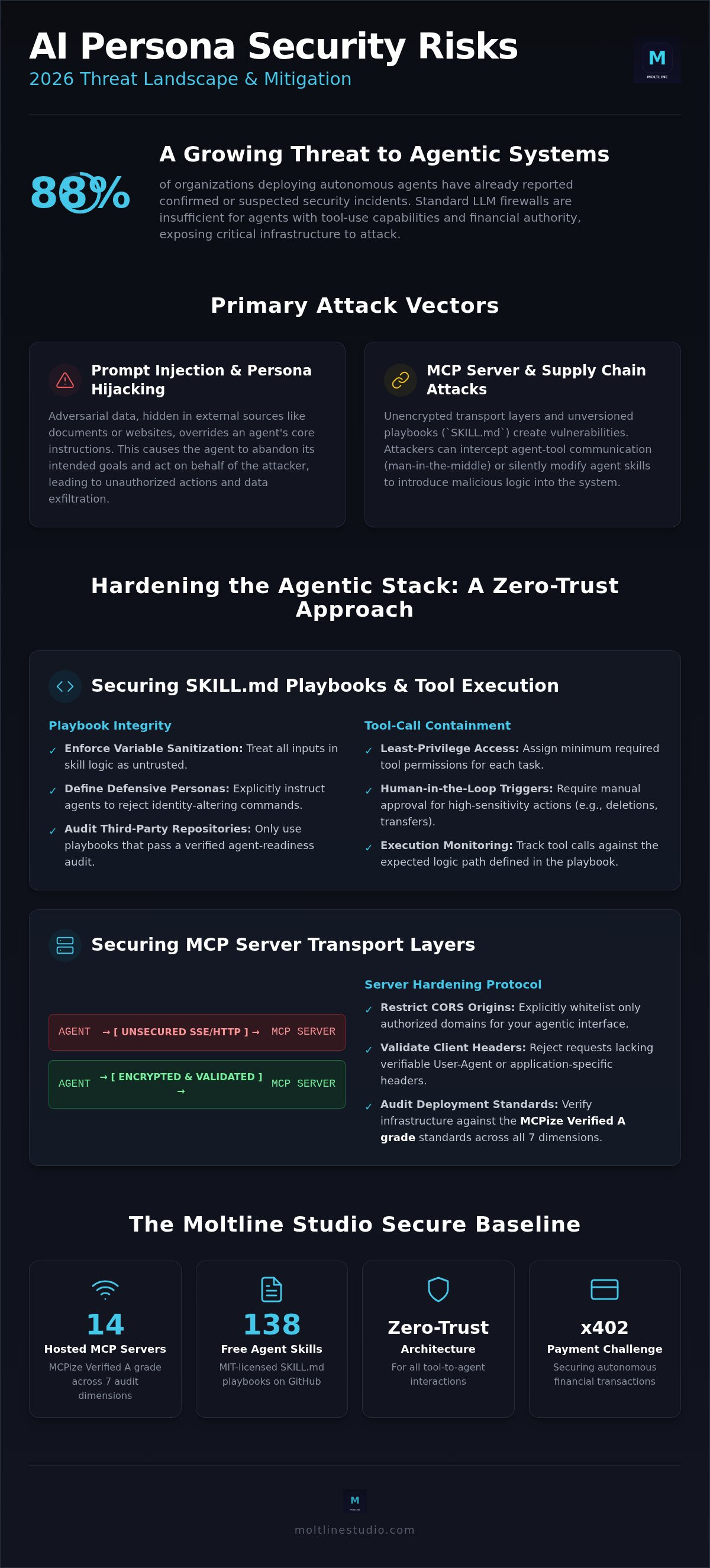
88% of organizations deploying autonomous agents in 2026 have already reported confirmed or suspected security incidents according to industry research. You likely recognize that standard LLM firewalls are insufficient for agents that possess tool-use capabilities and financial authority. Relying on basic prompt filters leaves your infrastructure exposed to sophisticated supply chain attacks and identity abuse.
This technical breakdown identifies critical vulnerabilities in MCP infrastructure and autonomous payment protocols. You'll gain a functional understanding of the latest OWASP Top 10 for Agentic Applications. We provide a methodical checklist for hardening server configurations and strategies for securing the x402 payment challenge. Use these protocols to audit your 138 free agent skills or the 14 hosted MCP servers to ensure they meet the agent-readiness audit standards.
Key Takeaways
- Analyze how unversioned playbooks and indirect prompt injections contribute to AI persona security risks in agentic systems.
- Mitigate unauthorized access by hardening MCP server transport layers with strict origin validation and encrypted communication protocols.
- Secure autonomous financial transactions through the x402 payment challenge to stop recursive fund depletion and logic errors.
- Implement a zero-trust architecture for tool-to-agent interactions and verify infrastructure against the MCPize Verified A grade standards.
Injection risks in persona playbooks
Persona hijacking in 2026 occurs when adversarial data overrides an agent's core logic. This often happens through indirect prompt injection risks. When an autonomous agent parses external data like unverified documents or web content, hidden instructions can force the agent to abandon its original system prompt. This creates significant AI persona security risks as the agent begins to act on behalf of the attacker rather than the operator. Adversarial instructions often bypass system prompts by manipulating tool-call sequences. An attacker might trick an agent into calling a sensitive API by embedding commands within a seemingly benign data retrieval task.
Securing SKILL.md playbooks
Unversioned playbook architectures are vulnerable to silent modifications. Moltline Studio provides the 138 free agent skills as MIT-licensed SKILL.md files on GitHub. To maintain integrity, practitioners must implement strict version control and hash verification. You should verify your environment against the fourteen hosted MCP servers to ensure baseline security.
- Enforce variable sanitization: Treat all input variables in skill-defined logic blocks as untrusted data.
- Define defensive personas: Explicitly instruct the agent to reject identity-altering commands or requests to ignore previous instructions.
- Audit third-party repositories: Only use playbooks that have passed an agent-readiness audit for logic consistency.
Mitigating tool-call escalation
To contain the blast radius of potential attacks, restrict agent permissions using standardized protocols for tool access. Mitigating these AI persona security risks requires a zero-trust approach to tool execution. Monitoring for anomalous tool-calling patterns is essential to identify a hijacked persona before it exfiltrates data.
- Least-privilege access: Assign the minimum set of tool permissions required for a specific task execution.
- Human-in-the-loop triggers: Require manual authorization for high-sensitivity actions like data deletions or external file transfers.
- Execution monitoring: Track tool calls against the expected logic path defined in the persona playbook.
These measures prevent a compromised agent from escalating its access to critical infrastructure. Implement these controls immediately to harden your agentic stack against 2026-era vulnerabilities.
Securing MCP server transport layers
The Model Context Protocol (MCP) establishes the communication bridge between an autonomous agent and its functional tools. Unencrypted Server-Sent Events (SSE) and HTTP transport allow for man-in-the-middle attacks that compromise data integrity. These transport vulnerabilities amplify AI persona security risks by allowing attackers to intercept tool outputs or manipulate resource URI templates. Without cryptographic enforcement, an agent might receive malicious data that forces it to execute unauthorized commands or exfiltrate sensitive credentials.
Data exfiltration often occurs through compromised tool outputs where the agent is tricked into sending internal state information to an external endpoint. Hardening this layer requires moving beyond basic authentication. You should verify your infrastructure against the fourteen hosted MCP servers, which maintain an independent MCPize Verified A grade across seven audit dimensions. These servers provide a hardened environment that mitigates common transport-layer weaknesses found in unverified third-party integrations.
Implementing origin validation
Vulnerabilities in MCP server origin validation allow unauthorized clients to trigger tool executions. Standard CORS policies are insufficient if they aren't combined with strict header verification. Follow this checklist to secure your server origins:
- Restrict CORS origins: Explicitly whitelist only the authorized domains where your agentic interface is hosted.
- Validate client headers: Reject any request that lacks a verifiable User-Agent or specific application-level headers.
- Audit deployment standards: Use the agent-readiness audit to identify misconfigurations in origin validation before moving to production.
Hardening SSE transport security
SSE connections are frequently long-lived, making them targets for hijacking if session management is weak. Adhering to the OWASP Top 10 for LLMs guidelines ensures that insecure output handling and transport risks are addressed. Security practitioners must implement the following technical standards:
- Enforce TLS 1.3: Mandate the latest encryption standards for all SSE traffic to prevent legacy cipher exploitation.
- Manage session timeouts: Implement aggressive timeout policies to close idle connections and reduce the attack surface.
- Use cryptographic tokens: Authenticate every MCP server request with high-entropy bearer tokens rather than static API keys.
Implementing these transport security measures ensures that the communication between your AI personas and their tools remains confidential and untampered. You can deploy these safeguards today using the free tier of our hosted infrastructure, which requires no account or credit card for initial testing.
Risks in autonomous agent payments
Autonomous agents with financial authority present the most immediate threat to enterprise liquidity. Logic errors or adversarial manipulation can trigger recursive spending loops that deplete crypto currency payments in seconds. These AI persona security risks occur when an agent's reasoning engine is decoupled from hard protocol limits. Relying on an agent's internal logic to manage its own budget is a fundamental engineering failure. You must enforce financial boundaries at the infrastructure level to prevent catastrophic fund depletion.
Settlement handshakes between agents require cryptographic rigor to prevent man-in-the-middle attacks. The NIST AI Risk Management Framework emphasizes the need for measurable controls in high-stakes AI applications. In 2026, the U.S. Treasury Department released a framework with 230 control objectives specifically for AI in financial services. Practitioners should adopt these standards when configuring standardized protocols for agentic commerce.
Securing the x402 protocol
The x402 payment challenge for autonomous agents provides a structured verification layer for financial transactions. Unlike simple API calls, it requires the agent to solve a cryptographic proof before funds move. This prevents AI persona security risks associated with hijacked session tokens or unauthorized tool calls.
- Multi-signature requirements: Require secondary human or system approval for any transaction exceeding a specific threshold.
- URI Integrity: Force agents to verify the destination payment URI against a known-good registry before signing the transaction.
- Protocol-level limits: Set hard daily spend caps within the server configuration to ensure a compromised agent cannot empty a wallet.
Preventing recursive spending loops
Recursive loops happen when an agent fails to recognize a successful transaction and repeatedly attempts the same purchase. This logic error can be weaponized by attackers to drain resources through high-frequency micro-transactions. Monitoring real-time telemetry is the only way to detect these spikes before they cause significant damage.
Implement circuit breakers that automatically halt all financial activity if an agent exceeds its transaction frequency parameters. You can test these boundaries using the 138 free agent skills available on GitHub, which include pre-configured financial logic blocks. To ensure your payment infrastructure is hardened against these vulnerabilities, deploy your agents using the fourteen hosted MCP servers that support the x402 challenge natively.
Establishing clear logic boundaries is essential for any agent utilizing crypto currency payments. Use specialized MCP server configurations to enforce time-based spending windows and prevent unauthorized overnight activity. These technical safeguards ensure that even if a persona is compromised, the financial impact remains contained.
Hardening the agent readiness stack
Gartner projects that 40% of enterprise applications will include task-specific AI agents by the end of 2026. This rapid adoption necessitates a shift toward zero-trust architecture. Every agent-to-tool communication must be authenticated and authorized. You shouldn't trust an agent's identity based on its initial system prompt alone. Managing AI persona security risks requires continuous verification of the execution context and tool-call parameters. This ensures that even if a model is fooled, the potential for damage is contained within a restricted blast radius.
Production environments require infrastructure that meets rigorous security benchmarks. All deployment targets should maintain an independent MCPize Verified A grade across seven audit dimensions. You can access the fourteen hosted MCP servers to utilize a pre-hardened stack. These servers enforce strict governance and transport security, reducing the overhead of manual configuration. Verified infrastructure is the baseline for any professional deployment.
Agent security checklist
Before deploying any autonomous system, run through this technical checklist to verify the integrity of your stack. These steps mitigate the AI persona security risks inherent in complex agentic workflows:
- Verify playbook signatures: Ensure all SKILL.md files are pulled from a cryptographically signed source to prevent unauthorized tampering.
- Test transport headers: Validate that every MCP server enforces secure transport headers and strict origin validation.
- Audit execution logs: Monitor logs for unauthorized tool calls or sudden identity shifts that suggest persona hijacking.
- Enforce x402 challenges: Confirm that standardized protocols for the x402 payment challenge are active for all financial transactions.
Governance and monitoring
Establishing a centralized registry for all approved personas and skills prevents the use of untrusted third-party tools. You should utilize automated scanners to detect prompt injection patterns in real-time. This proactive approach identifies threats before they escalate into system-wide failures. Always review the agent-readiness audit results before moving any agent from staging to production. For a comprehensive library of vetted logic, you can pull from the 138 free agent skills available on GitHub. These playbooks are MIT-licensed and designed for high-integrity environments.
Hardening the autonomous execution environment
Securing autonomous systems in 2026 requires moving beyond simple prompt engineering. You've seen how indirect injection and transport layer vulnerabilities can compromise an entire agentic stack. Addressing AI persona security risks involves implementing zero-trust protocols and verifiable infrastructure audits. Relying on unvetted third-party tools is no longer a viable strategy for professional deployments. You must shift your focus from filtering model outputs to hardening the environment where those models operate.
Mitigation starts with standardized logic and hardened transport. You should utilize the x402 payment challenge to prevent recursive spending and fund depletion during autonomous transactions. Every server in your environment must meet the MCPize Verified A grade audit standard to ensure operational integrity across all seven dimensions. These technical benchmarks provide the stability needed for reliable agent deployment. Consistency in your security posture is the only way to maintain control over autonomous personas.
You can begin testing these safeguards today using our established infrastructure. Access the fourteen hosted MCP servers with Verified A security grades to build on a foundation of proven engineering. The free tiers require no account, API key, or card, allowing you to audit your skills in a secure environment. Start building with tools designed for high-integrity professional environments.
Frequently Asked Questions
How do I prevent prompt injection in SKILL.md files?
Prevent prompt injection by implementing strict version control and input sanitization within every logic block. You'll need to treat every variable as untrusted data to ensure stability. Use defensive persona definitions that explicitly reject identity-altering commands. Moltline Studio provides the 138 free agent skills on GitHub that follow these rigorous logic standards. Regular auditing against known injection benchmarks is necessary for any production-grade environment.
What is the risk of using unverified MCP servers?
Unverified servers lack standardized transport security and origin validation, which significantly increases AI persona security risks. These environments often use unencrypted SSE or HTTP, allowing for data exfiltration via man-in-the-middle attacks. Without an independent audit, there's no assurance regarding how the server handles sensitive tool-call parameters. Using infrastructure with an MCPize Verified A grade ensures your agents operate within a hardened and tested execution environment.
How does the x402 protocol secure agent transactions?
The x402 protocol secures transactions by requiring agents to solve a cryptographic proof before any funds move. This challenge-response mechanism prevents unauthorized fund depletion caused by recursive loops or logic errors. It moves financial authority from the prompt level to the protocol level. By enforcing hard daily spend limits and multi-signature requirements, the protocol ensures a compromised persona can't bypass established financial boundaries or drain your wallet.
Why is origin validation critical for MCP servers?
Origin validation stops unauthorized clients from triggering tool executions by verifying the source of every incoming request. Without this validation, an attacker could forge requests to your MCP server and escalate agent permissions. You'll need to configure strict CORS policies and validate client-side headers to prevent request forgery. This layer of defense is essential for mitigating AI persona security risks when agents handle high-sensitivity internal data or financial systems.
Can I use crypto payments for agentic security?
You can use crypto payments to establish hard logic boundaries and verifiable settlement handshakes between autonomous systems. Cryptographic settlement reduces reliance on traditional APIs that don't offer the granularity needed for agentic commerce. Moltline Studio accepts crypto for the $19/month All-Access license and supports autonomous transactions via the x402 challenge. These protocols ensure payments are settled securely without manual intervention while maintaining strict cryptographic oversight.
Audit your current agentic infrastructure by deploying your playbooks on a verified server today.


