
Stop building tools for specific frameworks. The era of hard-coding agent capabilities into heavy orchestration layers is ending. By August 2026, the industry has pivoted toward a protocol-first mindset. The core of the LangChain vs MCP server decision isn't about which library is better; it's about where your logic lives. If your tool definitions break every time a model updates, you're carrying too much maintenance debt. You've likely struggled with high latency in complex chains and framework lock-in that makes migration impossible.
This article analyzes the architectural shift from framework-heavy orchestration to standardized, protocol-first workflows for production stability. You'll learn how to decouple your agent skills from the orchestrator using the stateless MCP 2026-07-28 specification. We'll preview a future where your infrastructure is versioned and your tools are securely sandboxed. We will explore how to reduce architectural complexity by moving toward managed MCP servers. This ensures your agentic workflows remain stable even as LangChain core packages evolve. We're moving beyond brittle prompt packs into a world of robust, engineering-led automation.
Key Takeaways
- Identify the core architectural differences in the LangChain vs MCP server debate to move beyond framework-specific tool definitions and technical debt.
- Leverage the MCP 2026-07-28 stateless protocol to build decoupled, versioned agent skills that maintain stability across various model updates.
- Reduce orchestration latency and improve security by implementing standardized transport layers like stdio and HTTP/SSE for agent-to-tool communication.
- Execute a migration strategy from framework-heavy bottlenecks to managed MCP servers for predictable performance in adversarial environments.
- Future-proof your infrastructure with an All-Access License for production-grade, adversarial-safe AI agent skills.
Beyond Orchestration Bloat: The Shift from Frameworks to Protocols
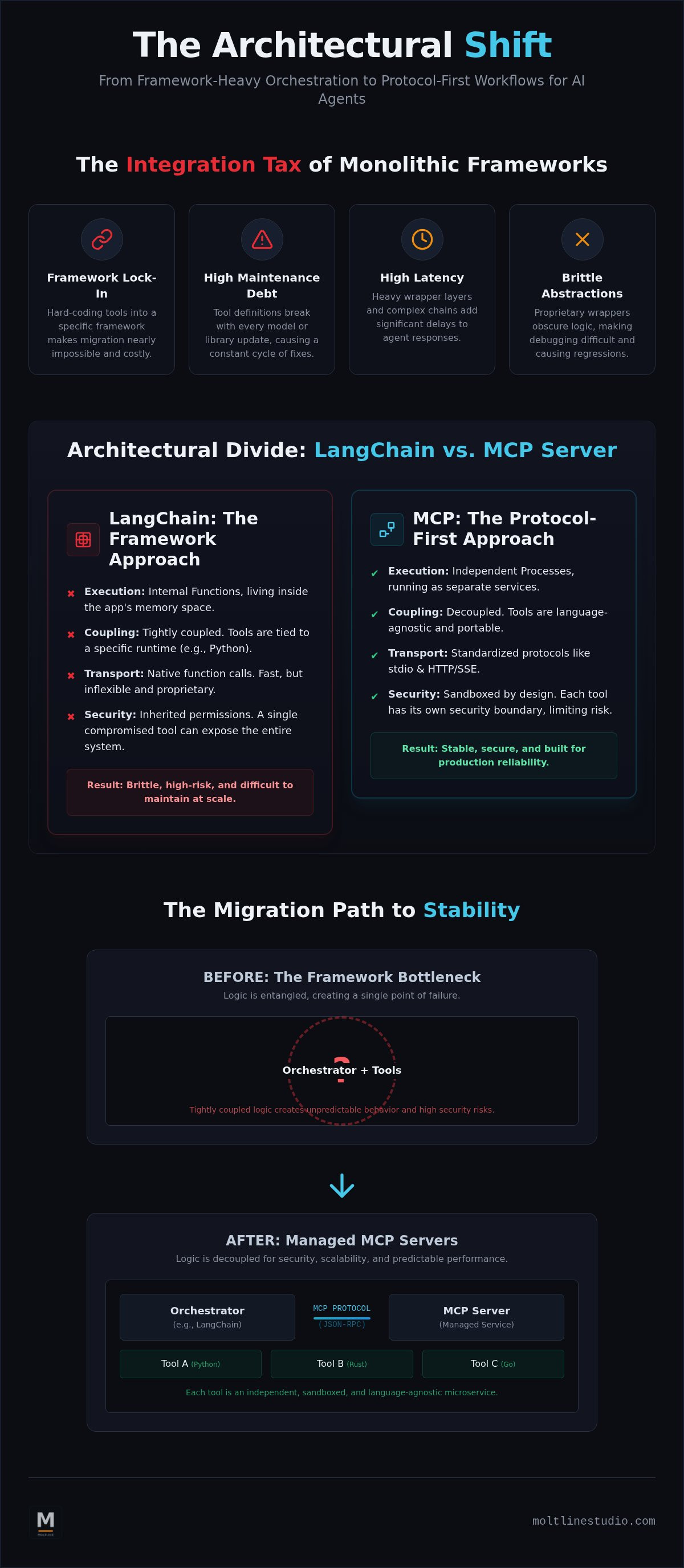
Heavy orchestration frameworks are hitting a wall. In the LangChain vs MCP server debate, the primary friction point is the "Integration Tax." Developers spend more time fighting framework abstractions than building core logic. This creates technical debt. Framework-specific tool definitions are brittle. They break during model updates or library upgrades. When you hard-code agent capabilities into a specific framework, you're locked into that ecosystem's maintenance cycle. This is unsustainable for production environments that require five-nines of reliability.
The 2026 landscape has matured. We now distinguish between orchestrators and interfaces. Orchestrators like LangChain handle the "brain" logic, such as planning and memory. Interfaces, specifically the Model Context Protocol (MCP), handle the "nervous system" of tool connections. Production-grade AI agents require this decoupled infrastructure. It ensures that a change in your LLM provider doesn't require a total rewrite of your tool library. Standardized JSON-RPC communication is replacing proprietary SDKs as the default for agentic workflows.
The Problem with Proprietary Abstractions
LangChain provides a comprehensive toolkit for building LLM applications. It's the industry standard for orchestration. However, its heavy wrapper layers often obscure the underlying logic. This lack of transparency complicates debugging. When tool-calling logic is buried in a framework-dependent stack, maintenance becomes a bottleneck. Versioned AI agent skills are difficult to manage within monolithic frameworks. You're often forced to update the entire stack just to fix one tool definition. This fragility leads to higher latency and increased risk of regression during deployments. Logic belongs in a specialized server, not a wrapper.
MCP as the Universal Connector
The Model Context Protocol offers a clean alternative. It's an open standard for tool integration. MCP separates the concern of tool execution from the orchestrator. The architecture is straightforward. An MCP Host connects to an MCP Client, which communicates with a specialized MCP server. This protocol-first design is model-agnostic. It uses standardized JSON-RPC communication over stdio or HTTP/SSE transports. The latest MCP 2026-07-28 specification has shifted to a stateless protocol. This simplifies deployment and improves scalability. It makes tools compatible with standard web infrastructure like load balancers. You're building for the protocol, not the framework. This shift ensures your agent skills remain secure and portable.
Decoupling your infrastructure reduces architectural complexity. It allows for adversarial-safe skill architectures. You can test a tool once and deploy it across any model that supports the protocol. This is the engineering-first approach to AI development. It prioritizes functional integrity over flashy promises. By moving logic to a managed MCP server, you eliminate framework bloat. Your focus returns to building high-performance agent skills that deliver predictable outcomes. In the current environment, stability is the most valuable feature.
Architectural Breakdown: LangChain Abstractions vs. MCP Protocol
The core of the LangChain vs MCP server architectural divide is the execution boundary. LangChain tools are internal functions. They live inside your application's memory space. MCP servers are independent processes. They communicate via standardized interfaces. This separation is critical for production stability. When tools are decoupled, a crash in a specific skill won't take down your entire orchestration layer.
Transport layers define how data moves. LangChain uses native Python or JavaScript function calls. This is fast but couples your tools to your runtime. MCP utilizes stdio for local connections or HTTP with Server-Sent Events (SSE) for remote access. These protocols allow tools to be written in any language, regardless of the orchestrator's environment. You can run a Rust-based data processor alongside a Python-based agent without dependency conflicts.
Security models differ significantly. LangChain tools usually inherit the permissions of the host process. If an agent compromises a tool, it has access to your entire environment. Standalone MCP servers provide a natural security boundary. You can sandbox each toolset in its own container. This limits the blast radius of adversarial inputs. It's an engineering-first approach to data safety.
Feature Matrix: Framework vs. Protocol
Interoperability is a primary driver for the protocol-first shift. An MCP server works across Claude, GPT-4o, and Llama 3.1 without modification. You don't need a specific wrapper for each model. Scaling to 100+ tools is manageable because the framework doesn't have to load every definition into memory. Managed MCP servers offer instant digital delivery and production-grade performance. This is more efficient than maintaining a library of self-hosted framework scripts that require constant dependency updates.
Logic and Control Flow
Control flow in LangChain often relies on LangChain Expression Language (LCEL). While powerful, LCEL adds a layer of abstraction that can be difficult to trace. MCP standardizes prompts, resources, and tools using JSON-RPC calls. This is a battle-tested communication method. It makes the developer experience predictable. You send a request; you get a structured response. There's no hidden framework magic. If you're looking for a stable, versioned tool infrastructure, consider exploring managed AI agent skills that utilize these standardized protocols.
State management also follows different philosophies. LangChain uses internal Memory components to track context. MCP 2026-07-28 moved toward a stateless protocol for better scalability. It uses standard web infrastructure like load balancers to manage traffic. This makes your agentic workflows more resilient under high loads. You aren't tied to a single stateful instance that could become a single point of failure.
Performance and Security in Production Environments
Production environments in 2026 demand more than just functional agents. They require predictable latency and verifiable security. When evaluating the LangChain vs MCP server trade-off, the performance overhead of framework orchestration often becomes a bottleneck. LangChain's internal tool-calling mechanism involves multiple layers of middleware and parsing. This adds measurable milliseconds to every execution cycle. In contrast, direct protocol calls via MCP use lightweight stdio or SSE transports. These bypass framework bloat, delivering near-native execution speeds for agentic skills.
Security is the second pillar of this architectural shift. Framework-based tools often run within the same memory space as the orchestrator. This creates a significant risk. A single prompt injection can potentially access the host's environment variables or local file system. Standalone MCP servers solve this by enforcing clear boundaries. By isolating tool logic into a separate process, you limit the blast radius of any successful attack. This sandboxing is essential for handling sensitive data or executing system-level commands.
Reliability also hinges on version control. Frameworks like LangChain evolve rapidly, often introducing breaking changes in core packages. Maintaining a stable workflow becomes a constant battle against dependency updates. The Model Context Protocol provides a stable, versioned interface. Once an MCP server is deployed, it remains functional regardless of how the orchestrator's library changes. This reduces maintenance debt and ensures that critical agentic logic doesn't fail during a routine framework patch.
Adversarial Safety and Sandboxing
Implementing injection-safe AI agent skills happens at the protocol level. Standalone MCP servers allow you to define strict schemas and validation rules that the LLM cannot bypass. This isolation ensures sensitive data never touches the model's reasoning space unless explicitly permitted. Moltline's tested skills prioritize this functional integrity. They're built on adversarial-safe architectures that have been rigorously vetted for production use. You aren't just deploying a script; you're deploying a secure endpoint.
Infrastructure Stability for 2026
Critical systems can't afford the fragility of generic prompt packs. The move toward structured agentic logic requires a reduced attack surface. By eliminating unnecessary framework dependencies, you minimize potential vulnerabilities. Tested AI agent skills provide a foundation for long-term stability. This approach moves the industry away from "magic" orchestration and toward disciplined systems engineering. Relying on managed, versioned skills ensures your infrastructure is ready for the adversarial conditions of modern deployment. It’s about building for resilience, not just capability.
Implementation Strategy: Integrating MCP with Your Current Stack
Transitioning from framework-heavy orchestration to a modular protocol requires a methodical approach. The LangChain vs MCP server decision doesn't have to be binary from day one. Most production teams adopt a hybrid strategy to minimize downtime. Start by auditing your existing LangChain tools. Identify bottlenecks where high latency or frequent breaking changes disrupt your workflows. These are your primary candidates for migration.
Once identified, port these tool definitions to a standardized MCP server structure. This move centralizes your logic. It removes the dependency on the orchestrator's internal runtime. Use the stateless MCP 2026-07-28 specification to ensure your tools are compatible with modern web infrastructure. The transition involves four distinct phases:
- Phase 1: Audit existing agents for framework-heavy bottlenecks and brittle tool-calling logic.
- Phase 2: Port legacy tool definitions into a standalone MCP server using JSON-RPC standards.
- Phase 3: Deploy adapters to bridge the gap between your current LangChain orchestrator and the new protocol.
- Phase 4: Decommission framework-specific tools in favor of a fully decoupled, protocol-first architecture.
The Adapter Pattern
The adapter pattern serves as a critical bridge. You don't need to rewrite your entire orchestration layer to benefit from protocol-first design. Use langchain-mcp-adapters to connect your existing agents to specialized servers. This allows you to manage multiple MCP servers within a single LangChain agent seamlessly. While the 2026 protocol is stateless, these adapters help manage session context across protocol boundaries. This ensures your agent maintains a coherent reasoning chain without losing access to external resources. For engineers ready to eliminate maintenance debt, you can get an All-Access License to deploy production-grade AI agent skills immediately.
Scaling to Production
Scaling requires choosing the right transport layer. Use stdio for local agent execution where low-latency communication is paramount. For remote or distributed teams, configure HTTP with Server-Sent Events (SSE). This setup supports high-performance environments and integrates easily with existing load balancers. Organize your AI agent skill bundles by functional domain. This modularity simplifies version control and testing. It prevents the "monolithic bloat" common in early framework-based stacks. By focusing on tested, versioned skills, you ensure your infrastructure remains resilient under adversarial conditions. This is the path to a stable, production-ready AI stack in 2026.
Future-Proofing with Moltline Studio’s Managed MCP Infrastructure
Self-hosting MCP infrastructure introduces significant hidden costs. Industry data from 2026 suggests building a custom server can cost between $50,000 and $150,000 per integration annually. Managed solutions provide a more efficient path for rapid deployment. The Moltline Studio All-Access License is the 2026 standard for engineers prioritizing utility over maintenance debt. It offers a stable, versioned foundation for agentic workflows. You don't need to manage the underlying transport layers or security patches. This allows your team to focus on the LangChain vs MCP server orchestration logic that actually drives value. You avoid the "Integration Tax" that plagues framework-dependent stacks.
Moltline Studio’s Catalog of Agentic Skills
Engineering production-grade agents requires more than generic prompt packs. You need tested, versioned logic. Moltline Studio’s catalog includes specialized AI agent skills and persona bundles designed for specific identities. These tools are built on adversarial-safe architectures. They prevent common prompt injection attacks at the protocol level. Integrating these skills into your production stack is straightforward. The All-Access License simplifies infrastructure procurement. It provides a single point of entry for a wide range of production-ready capabilities. You get functional integrity without the integration tax of framework-specific wrappers. Every skill is versioned to ensure long-term stability in critical systems.
The Crypto-Powered Development Workflow
The procurement process reflects the speed of modern software engineering. Moltline Studio uses a secure, one-time cryptocurrency licensing model. There are no monthly SaaS subscriptions. There are no fiat payment delays. You get instant digital delivery of license keys for immediate engineering use. This aligns with the needs of independent software studios and high-performance teams. It ensures immediate access to the tools you need without recurring overhead. Secure your AI agent all-access license today to stabilize your 2026 production stack.
One-time purchases provide predictable costs. You own the license; you control the deployment. This model respects the autonomy of builders. It avoids the "lock-in" associated with traditional subscription platforms. By choosing managed MCP server infrastructure, you eliminate the fragility of self-hosted scripts. Your agents become more resilient. Your security posture improves. The focus shifts from managing servers to delivering functional, reliable AI outcomes. This is the disciplined approach to 2026 AI infrastructure.
Standardizing Your Agentic Stack for 2026
Choosing between a LangChain vs MCP server architecture is a decision between framework dependency and protocol-first stability. Decoupling tool logic into a standalone MCP environment eliminates the "Integration Tax" that hinders rapid scaling. You gain adversarial-safe skill architectures and a versioned infrastructure that remains resilient during library updates. Managed servers provide the most direct path to production. They remove the engineering burden of maintaining custom transport layers and proprietary SDKs.
Get the All-Access License for production-grade MCP servers to access a curated catalog of versioned AI agent skills. Instant digital delivery via cryptocurrency ensures your team can deploy immediately. This engineering-led approach significantly reduces framework maintenance debt while improving security boundaries. It's time to stop fighting abstractions and start building with protocols. Your production environment deserves a foundation built on functional integrity and predictable performance.
Frequently Asked Questions
Is MCP a replacement for LangChain in 2026?
No, MCP isn't a direct replacement for LangChain. It's a communication protocol that standardizes how agents interact with tools. LangChain remains a powerful orchestrator for complex reasoning chains. By using a specialized MCP server, you decouple your tool logic from the framework. This setup reduces technical debt. It allows you to swap orchestrators or update models without rewriting your entire tool library. They are complementary technologies in a modern stack.
Can I use Moltline MCP servers with non-LangChain frameworks?
Yes, you can use these servers with any framework that supports the Model Context Protocol. This includes Haystack, CrewAI, or even custom-built Python and TypeScript agents. The protocol-first design ensures your AI agent skills aren't locked into a single ecosystem. You interact with the server via standardized JSON-RPC calls. This flexibility is essential for engineering teams that need to maintain model-agnostic toolsets across diverse production environments.
Do Moltline AI agent skills support Claude and Anthropic models?
Yes, our AI agent skills are fully compatible with Claude and other Anthropic models. Claude Desktop and Claude Code act as native MCP hosts. This allows for seamless integration of versioned skills directly into your agentic workflows. Because MCP is an open standard, these skills also function with any model that supports tool-calling via an MCP client. This ensures broad compatibility across the 2026 AI model landscape.
Why does Moltline use cryptocurrency for license payments?
We use cryptocurrency to ensure instant digital delivery and engineering-level privacy. Traditional fiat payments often involve processing delays and recurring billing complexities. Our model focuses on a one-time license purchase. This eliminates the need for monthly SaaS subscriptions. Crypto transactions allow for immediate access to license keys. It's an efficient workflow designed for independent developers and software studios who value speed and transparent, one-time costs.
Are MCP servers more secure than standard LangChain tools?
Yes, an MCP server provides a superior security model through process isolation. Standard LangChain tools often run with the same permissions as the host application. If a prompt injection occurs, the model might access sensitive local resources. MCP servers act as a sandbox. They enforce clear boundaries between the LLM's reasoning space and the tool's execution logic. This architecture minimizes the blast radius of adversarial inputs in critical systems.
How do versioned AI agent skills improve production stability?
Versioned skills provide a predictable execution environment. Framework updates in the LangChain vs MCP server ecosystem often introduce breaking changes that disrupt unversioned tools. By using versioned, production-grade skills, you ensure that your agent's capabilities remain constant. You can test a specific version and deploy it with confidence. This approach reduces maintenance overhead. It prevents the "breaking change" cycle that often plagues framework-dependent orchestration layers in production.
Is there a free tier for testing Moltline MCP tools?
Yes, we offer Free Tier Tools for developers to test our architecture. These tools allow you to verify the performance and security of our MCP implementation before committing to a license. You can evaluate the transport layers and JSON-RPC communication patterns in your local environment. Once you're ready for production-grade performance and adversarial-safe architectures, you can upgrade to the All-Access License. This ensures a low-risk entry point for engineering teams.


