
In 2026, a prompt is no longer a standalone product. If your autonomous agent relies on unversioned text strings to execute critical functions, you aren't building a system; you're managing a technical liability. You've likely felt the frustration of brittle agents that fail on simple edge cases or the security risks exposed by the Clinejection incident in early 2026. Engineering teams cannot afford the 12 percent gap in safety systems that still leaves production environments vulnerable to prompt injection and unauthorized tool execution.
This article provides the technical blueprint to transition from fragile prompts to robust claude agent skills that function as versioned infrastructure. You'll learn how to deploy stable, specialized capabilities that withstand adversarial conditions and reduce engineering overhead. We will examine the implementation of the skills-2025-10-02 beta header, the integration of Model Context Protocol (MCP) servers, and strategies for maintaining enterprise-grade version control across your agentic workflows. It is time to move past the hype and focus on functional integrity and predictable outcomes in your deployment pipeline.
Key Takeaways
- Transition from fragile prompt-based instructions to structured logic frameworks to ensure agents execute with engineering precision.
- Standardize tool delivery using the Model Context Protocol (MCP) to manage and version claude agent skills for production stability.
- Architect injection-safe agents by implementing rigorous input sanitization and isolated execution environments to mitigate evolving security risks.
- Deploy specialized toolsets for autonomous coding and data synthesis to reduce latency and minimize engineering overhead in complex workflows.
- Scale development rapidly with the Moltline Studio All-Access License, providing a curated library of production-grade skills via a one-time crypto payment.
What are Claude Agent Skills in 2026?
In 2026, the industry has abandoned the myth of the "magic prompt." Production-grade systems require more than just clever phrasing; they require claude agent skills designed as executable, versioned modules. These frameworks bridge the gap between a raw LLM and a functional Intelligent agent. Models like Claude Opus 4.6 provide the reasoning engine, but skills provide the mechanical interface. High-density skill architectures are now mandatory for these models to ensure they operate within strict safety and performance bounds. Model-native capabilities are the internal weights. External skill integrations are the specific tools you hand the model to interact with your proprietary data and infrastructure.
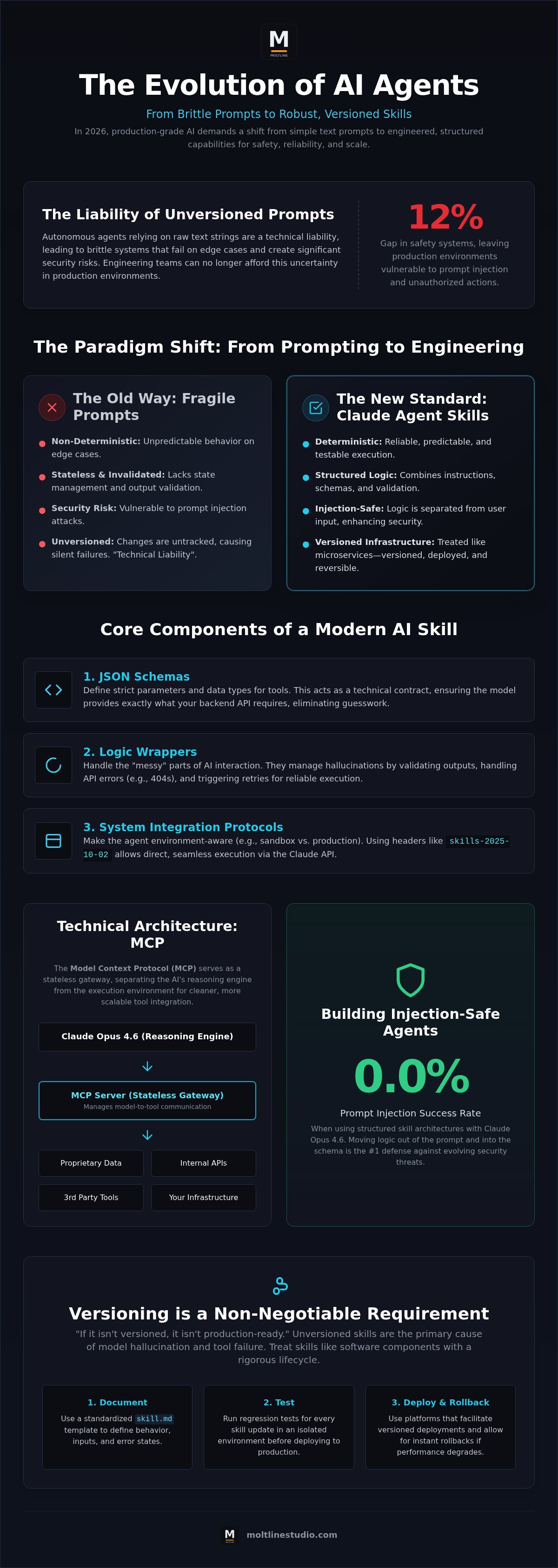
Claude Opus 4.6 demonstrates a 0.0% success rate for prompt injection attacks in certain benchmarks when using structured skill architectures. This isn't accidental. It's the result of moving logic out of the prompt and into the schema. Sonnet models prioritize execution speed. They need high-density skills to minimize the token overhead of long-winded instructions. Efficiency is the new engineering standard for 2026.
The Shift from Prompts to Agentic Logic
Simple text prompts fail in production because they lack state and validation. They're non-deterministic. In a high-stakes environment, an agent needs to know exactly how to handle a 404 error or a malformed JSON response. A skill isn't just a block of text. It's a combination of instructions, schemas, and execution logic. Claude Agent Skills are versioned infrastructure components that enable reliable, multi-step task execution. This shift allows developers to treat AI capabilities like microservices. You don't prompt a microservice; you call it. Since the launch of the Open Standard for Agent Skills on December 18, 2025, the focus has shifted entirely to this structured approach.
Core Components of a Modern AI Skill
Modern skills rely on three distinct pillars. First, JSON schemas define the parameters. These schemas ensure the model provides the exact data types required by your backend API. Second, logic wrappers manage the "messy" parts of AI. They handle model hallucinations by validating outputs and triggering retries when necessary. Third, system-level integration protocols allow agents to be environment-aware. This means the skill knows if it's running in a sandbox or a production database. Using the skills-2025-10-02 beta header, developers can now link these components directly into the Claude API for seamless execution. This architecture ensures that every action taken by the agent is logged, versioned, and reversible.
The Technical Architecture: MCP and Skill Versioning
Deploying claude agent skills at scale requires a standardized delivery mechanism. The Model Context Protocol (MCP) serves as this backbone. It separates the reasoning engine from the execution environment. This architecture follows the foundational principles of Claude's agent skills, ensuring that tools are integrated rather than merely described. By using MCP, developers manage complex toolsets without bloating the system prompt. It provides a clean interface for model-to-tool communication.
Implementing Model Context Protocol (MCP) Servers
Production-grade MCP servers act as stateless gateways between Claude and your infrastructure. Managed MCP instances often provide lower latency by optimizing the handshake between the model and the data source. Self-hosted options offer more control but increase maintenance overhead. Integrating external data requires strict adherence to MCP schemas. These schemas act as a technical contract. They ensure the model understands the tool's specific functional bounds. For teams looking for pre-configured reliability, using tested MCP servers reduces initial engineering friction and setup time.
Versioning and Production Stability
Stability in 2026 depends entirely on version control. Unversioned skills are a liability. A slight change in a tool's description can cause the model to hallucinate parameters or fail to trigger the tool entirely. Every skill update must undergo regression testing in an isolated environment. Use a standardized skill.md template to document behavior, expected inputs, and error states. This ensures team-wide consistency across the development lifecycle. Platforms like Agentman now facilitate this by allowing instant rollbacks when a new skill version degrades performance. Treat your skills like software. If it isn't versioned, it isn't production-ready.
Skill bundles define an agent's functional identity. A "Security Researcher" persona isn't just a prompt; it's a collection of versioned skills for scanning, analysis, and reporting. Bundling allows for modular agent design. You can swap out a specific skill without rebuilding the entire persona architecture. This modularity is essential for scaling complex agentic workflows across an enterprise. It allows different teams to contribute specialized capabilities to a shared agent pool without creating dependency hell.
Essential Claude Skill Categories for Developers
In 2026, the utility of claude agent skills is measured by their ability to execute complex, multi-step engineering tasks without human intervention. Generic coding assistance has evolved into specialized, job-oriented modules. While the official open-source Agent Skills repository provides a baseline, production environments require higher logic density. Developers now categorize skills by their functional impact on the software development lifecycle (SDLC). This move beyond simple text generation enables active system manipulation.
Claude Coding and Engineering Skills
Modern engineering skills handle more than just boilerplate. They manage architectural refactoring across entire repositories. Agents equipped with these skills identify technical debt. They propose structural changes that maintain system integrity. As of August 2026, Claude Code includes bundled skills like /doctor for troubleshooting and /verify for ensuring code quality. These are not prompts. They are executable commands. They interact with local file systems and remote CI/CD pipelines. Integrating these skills into version-controlled repositories allows teams to automate unit test generation. It enforces coding standards at the commit level. This reduces the cognitive load on senior engineers while maintaining a high bar for production code.
Automation and Workflow Orchestration
Autonomous agents must navigate multi-tool environments to be effective. Automation skills focus on cross-platform API orchestration. A research agent might use a synthesis skill to pull data from three separate databases. It validates the schema. It then triggers a deployment hook. This requires structured data processing capabilities that go beyond basic RAG. By June 2026, community directories like SkillsMP have indexed approximately 1.9 million public skills. Most of these focus on high-volume information retrieval. Developers use specialized claude agent skills to ensure data remains consistent as it moves through logic gates. This orchestration is critical for DevOps agents managing cloud infrastructure. A single failed parameter can halt a deployment pipeline. Reliable execution is the only metric that matters.
Effective agent design also includes persona-driven communication skills. These are essential for customer-facing interfaces where the agent must maintain a specific technical tone while executing backend operations. Separating the communication logic from the functional execution ensures the agent remains helpful without compromising security. This layered approach is the hallmark of professional agent engineering in 2026. It prioritizes functional boundaries over conversational fluff.
Security and Safety: Building Injection-Safe Agents
Production AI agents require more than model-level safety. While Anthropic's safety systems block 88% of prompt injection attempts, that 12% gap represents a critical failure point in agentic infrastructure. Basic prompt safety is insufficient for agents with system-level permissions. The "Clinejection" supply chain compromise on February 17, 2026, highlighted how vulnerable agentic workflows become when they lack isolated execution environments. Secure claude agent skills require an architecture that treats every model output as a potential adversarial command. You cannot rely on the model's internal weights to prevent all unauthorized actions.
Anthropic's own research preview, Claude Code Security, has already identified over 500 vulnerabilities in production open-source codebases as of February 2026. This data underscores the necessity of moving beyond "vibes-based" security. Engineering-first teams must implement a zero-trust model for agentic tool use. This involves architecting agents that operate within restricted sandboxes where every tool call is logged and validated against a strict schema.
Mitigating Prompt Injection in Tool Use
Malicious inputs exploit tool-calling schemas by hiding instructions inside data parameters. If an agent has permission to write to a file system, a poisoned input could force it to overwrite critical system configurations. You must implement strict validation layers between Claude and your MCP servers. These layers act as a technical firewall. They verify that the model's tool calls align with predefined logic gates and data types before execution. Downloading unverified third-party skills from community registries exposes your infrastructure to severe security risks and potential remote code execution. Always use the "dangerously-skip-permissions" flag with extreme caution, as it bypasses the interactive approval mode designed to stop these exact exploits.
Tested vs. Untested Skill Libraries
Community directories like SkillsMP host millions of public skills, but few undergo adversarial testing. Using community-sourced skills in production is a gamble with your system's integrity. Quality benchmarks for production-grade skills include input sanitization, schema enforcement, and error-handling robustness. Professional engineering teams prioritize tested agentic infrastructure over experimental community code. This focus on reliability ensures that your agents perform predictably even when facing adversarial inputs. A single unvetted skill can compromise your entire data pipeline.
Build with confidence by acquiring injection-safe Claude agent skills through our All-Access License. Our catalog provides the versioned and tested alternative to fragile community prompts, ensuring your deployment remains stable and secure.
Scaling with Moltline All-Access Skill Bundles
Engineering teams face high overhead when sourcing fragmented tools from disparate repositories. Scaling requires a unified, version-controlled library. Moltline Studio provides claude agent skills designed for production-grade performance. These are not experimental snippets. They are tested infrastructure components ready for immediate integration into enterprise workflows. This approach eliminates the trial-and-error phase associated with community-sourced code. High-performance teams need a reliable baseline to build autonomous systems that don't fail under adversarial conditions.
The All-Access License Model
SaaS procurement often creates friction for engineering teams. Recurring monthly fees complicate budget planning and project lifecycle management. Our AI Agent All-Access License: Engineering Your 2026 Production Stack replaces the subscription model with a one-time purchase. This provides permanent access to our full catalog. The library includes high-density MCP servers and persona bundles tailored for specific industrial jobs. You own the assets; you don't rent them. This model prioritizes long-term stability over vendor lock-in. It allows you to deploy claude agent skills across multiple environments without worrying about fluctuating monthly costs or seat limits.
Deployment and Crypto Logistics
Speed is the primary requirement for modern deployment pipelines. We use exclusively cryptocurrency payments to ensure instant delivery. You bypass fiat-related delays and administrative overhead. Once the transaction is confirmed, you receive your license key immediately. This allows for rapid scaling of agentic capabilities across your environment. For initial validation, developers can access our Free Tier Tools to test basic integrations. When you're ready for production-grade performance, the All-Access License provides the injection-safe architecture required for 2026 standards. Instant digital delivery via crypto ensures your development momentum is never interrupted by traditional banking cycles.
Integrating Moltline persona bundles into your existing production agent workflows is a methodical process. Each bundle includes a suite of versioned skills that define the agent's functional identity. You don't need to rebuild the logic from scratch. You simply link the MCP servers to your Claude instance using the protocols discussed in previous sections. This modular approach reduces development time by weeks. It ensures your agents are reliable from day one. High-performance teams value this efficiency because it allows them to focus on unique business logic rather than tool-use plumbing. By utilizing these pre-configured bundles, you ensure that your agents maintain a consistent technical standard across all customer-facing and internal interfaces.
Deploying Reliable Agentic Infrastructure
The shift from basic prompting to engineering claude agent skills as versioned infrastructure is the mandatory standard for 2026. Production stability depends on moving logic out of text strings and into structured MCP schemas. Security isn't a model-side guarantee; it's an architectural requirement. High-performance teams must prioritize adversarial-tested skill bundles to close the safety gaps left by generic community tools. Reliable execution isn't about the best prompt. It's about the most robust system.
Scaling your autonomous capabilities shouldn't involve SaaS procurement friction or recurring fee structures. You can secure a foundation built on production-grade MCP infrastructure today. This approach ensures your agents remain functional, secure, and ready for adversarial environments. Our catalog provides the versioned, tested alternative to fragile community code.
Get the All-Access License and unlock the Claude Skill Catalog to benefit from instant crypto delivery and immediate deployment. Build your 2026 stack on a foundation of technical integrity and predictable performance. Your agents are only as capable as the tools you provide them.
Frequently Asked Questions
What is the difference between a prompt and a Claude agent skill?
A prompt is a stateless text instruction that relies on model interpretation. In contrast, claude agent skills are versioned infrastructure components that include JSON schemas, validation logic, and environment-aware execution scripts. While prompts are often brittle and non-deterministic, skills provide a standardized interface for tool-calling. This ensures the model interacts with external systems according to strict technical contracts, reducing hallucinations and improving production reliability.
How do I install an MCP server for my Claude agent?
Installation involves configuring a stateless gateway that communicates with Claude via the Model Context Protocol. You must define the server endpoint and provide the necessary authentication credentials within your agent's configuration file. Managed MCP servers often provide lower latency and pre-configured schemas. Once the server is active, you link it to the model using the skills-2025-10-02 beta header. This allows the agent to discover and invoke tools dynamically.
Are Moltline agent skills compatible with Claude 3.5 Sonnet?
Yes, all skills in our catalog are fully compatible with Claude 3.5 Sonnet and Claude 4.6 Opus. We optimize these skills for high-density logic to minimize token overhead, which is critical for the speed-focused Sonnet architecture. Each skill undergoes rigorous testing to ensure it triggers correctly across different model weights. This compatibility ensures that your autonomous workflows remain stable even as you switch between different performance tiers in the Claude model family.
Can I use these skills for autonomous coding agents?
Absolutely. Our engineering-focused skill bundles are designed specifically for autonomous coding tasks. These include modules for complex architectural refactoring, unit test generation, and direct CI/CD pipeline interactions. By integrating these claude agent skills into your version-controlled repositories, you enable agents to perform system-level operations. This goes beyond simple code completion, allowing the agent to troubleshoot environment errors using bundled tools like /doctor and /verify for production-grade code quality.
Why does Moltline exclusively use cryptocurrency for payments?
We use cryptocurrency to eliminate the friction and delays associated with traditional fiat banking and monthly SaaS procurement cycles. This model allows for instant digital delivery of license keys, enabling your engineering team to deploy tools immediately. By removing recurring subscription fees, we provide a one-time license model that simplifies long-term budget planning. Transactions are processed via secure crypto gateways, ensuring a transparent and efficient exchange for professional developers who value deployment speed.
Is it safe to use agent skills from external registries like GitHub?
Using unverified skills from community registries like GitHub or SkillsMP involves significant security risks. These libraries often lack adversarial testing and input sanitization, leaving your agents vulnerable to prompt injection attacks. The Clinejection incident in February 2026 proved that unvetted agentic code can lead to system-wide compromises. We recommend using only tested, versioned skill libraries that include injection-safe architectures and strict validation layers to protect your production infrastructure.
What is included in the Moltline All-Access License?
The All-Access License provides permanent access to our entire catalog of production-grade assets. This includes a comprehensive library of specialized claude agent skills, high-performance MCP servers, and pre-configured persona bundles. You also receive access to our injection-safe architectures with instant digital delivery via crypto. Unlike monthly SaaS models, this is a one-time purchase that grants your team the right to use these versioned components across all your internal and customer-facing agentic workflows.
How do I handle versioning for my agentic skill library?
Effective versioning requires treating skills like software infrastructure. You should maintain a consistent skill.md template for every module, documenting behavior, schemas, and error states. Every update must undergo regression testing in an isolated sandbox before production deployment. Using versioned headers in your API calls ensures that your agents don't break when a tool's underlying logic changes. This methodical approach allows for instant rollbacks and maintains long-term stability in complex agentic ecosystems.


