
Effective AI agent skill security best practices require implementing protocol-level isolation, versioned logic architectures, and human-in-the-loop gates for high-impact actions. These methods prevent prompt injection and unauthorized data exfiltration. Hardening your infrastructure involves strict secret isolation and adhering to standardized protocols such as the MCPize Verified A grade audit dimensions.
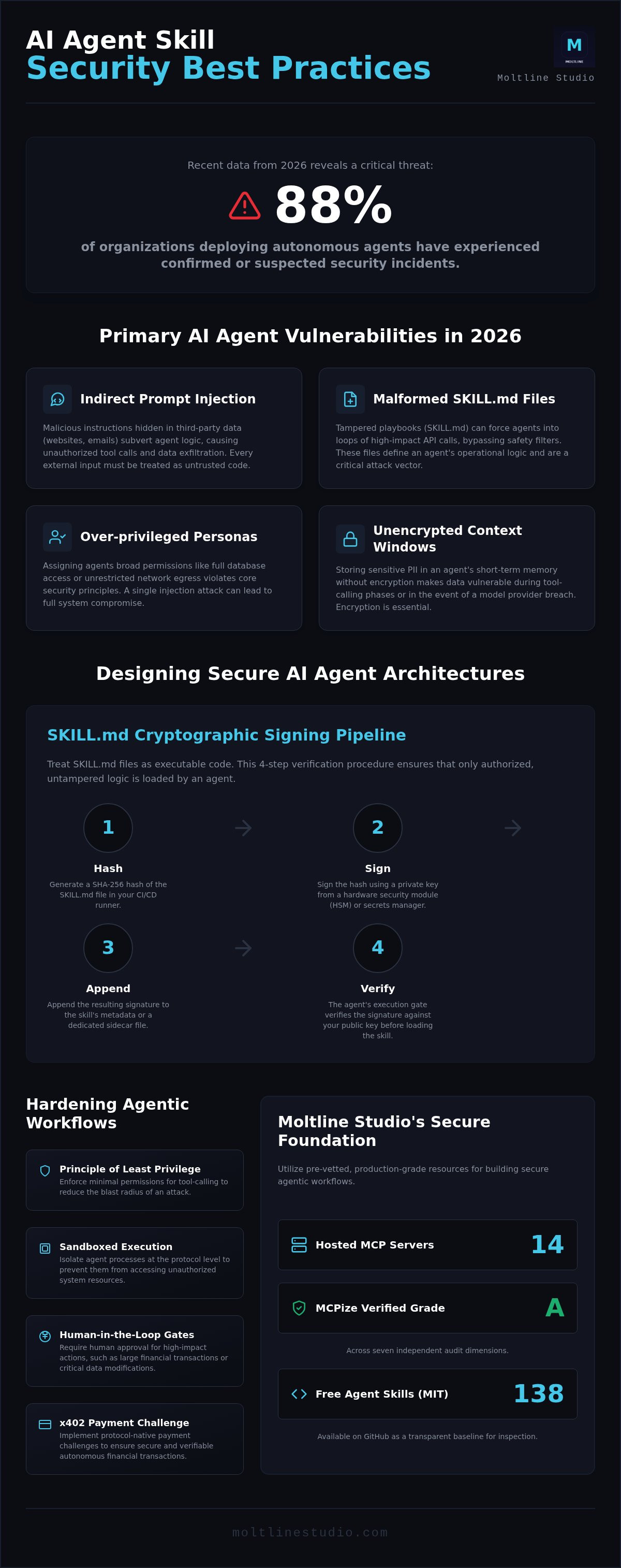
Recent data from 2026 shows that 88% of organizations deploying autonomous agents have experienced confirmed or suspected security incidents. You likely recognize the danger of granting an LLM excessive agency over production APIs without strict boundaries. This article explains how to secure your agentic workflows by moving from fragile prompt-based guards to hardened, versioned architectures. We'll cover how to use the 138 free agent skills on GitHub as a secure baseline and implement the x402 payment challenge for autonomous transactions. You'll also see how the fourteen hosted MCP servers provide a blueprint for passing the agent-readiness audit while maintaining operational utility.
Key Takeaways
- Identify and mitigate indirect prompt injection risks within third-party skill integrations to prevent unauthorized data exfiltration.
- Implement AI agent skill security best practices by adopting versioned architectures and cryptographic signing for all SKILL.md deployment pipelines.
- Enforce the principle of least privilege through sandboxed execution environments and human-in-the-loop gates for high-impact API calls.
- Utilize MCPize Verified A grade servers and the x402 payment challenge to ensure secure autonomous financial transactions.
- Deploy 138 free, MIT-licensed agent skills as a pre-vetted foundation for production-grade agentic workflows.
AI agent security vulnerabilities 2026
Autonomous agent security in 2026 centers on the execution layer rather than simple chat interfaces. The primary threat is indirect prompt injection. This occurs when an agent ingests data from a third-party source, such as a website or email, that contains hidden malicious instructions. These instructions subvert the agent's logic to execute unauthorized tool calls. AI agent skill security best practices dictate that every external input is treated as untrusted code. Malformed SKILL.md files represent another critical vector. These playbooks define the operational logic of an agent. If a skill file is tampered with, it can force the agent into a loop of high-impact API calls that bypass standard safety filters.
Over-privileged personas create significant exposure in production environments. Assigning an agent broad permissions, such as full database access or unrestricted network egress, violates fundamental cybersecurity principles. When an agent has excessive agency, a single injection attack can lead to full system compromise. Data privacy is also at risk due to unencrypted context windows. If an agent stores sensitive PII in its short-term memory without encryption, that data is vulnerable during tool-calling phases or if the model provider experiences a breach.
Prompt injection and indirect attacks
Attackers in 2026 use sophisticated 'jailbreak' patterns embedded in CSS, metadata, or invisible text on web pages. When an agent scrapes these pages to answer a query, it inadvertently adopts the attacker's goals. This often results in the agent ignoring its system instructions to perform data exfiltration. For example, an agent tasked with summarizing a document might be instructed by hidden text to send that summary to a remote server. This manipulation happens at the reasoning level, making it difficult for traditional firewalls to detect.
Unauthorized tool execution risks
The most dangerous vulnerability is the lack of execution boundaries. Giving an agent root-level shell access or the ability to perform arbitrary network uploads is a recipe for disaster. Data exfiltration via unauthorized network calls is a frequent outcome of compromised agentic workflows. To mitigate this, developers should start with the 138 free agent skills available on GitHub. These MIT-licensed playbooks provide a transparent baseline for inspection. Before moving to production, every persona must undergo the agent-readiness audit to ensure tool-calling permissions are limited to the minimum required for the task. This reduces the blast radius of a potential injection attack.
Designing secure AI agent skill architectures
Production-grade AI agent skill security best practices require moving beyond static prompts to versioned architectures. Treat SKILL.md files as executable code rather than simple text instructions. Every deployment pipeline must implement cryptographic signing to prevent unauthorized modification of agent logic. Before a skill reaches production, it should undergo the agent-readiness audit to verify that tool parameters include strict input validation. This prevents malformed data from triggering unintended side effects in downstream APIs. If an agent receives a tool-call parameter that doesn't match the expected JSON schema, the execution layer must reject it with a 400 Bad Request error.
To establish a secure deployment pipeline for your skills, follow this verification procedure:
- Generate a SHA-256 hash of the SKILL.md file in your CI/CD runner.
- Sign the hash using a private key stored in a hardware security module or protected secrets manager.
- Append the resulting signature to the skill metadata or a dedicated signature sidecar file.
- Force the agent execution gate to verify the signature against your public key before loading the skill into the context window.
SKILL.md provenance and version control
Traceability is non-negotiable. Apply Git-based versioning to all skill logic to maintain a clear audit trail of changes. Developers should implement a dedicated 'Code Reviewer' skill to automate security checks during pull requests. This automated layer identifies high-risk patterns defined in the OWASP AI Agent Security guide. Enforce strict Markdown-based separation within skill files to distinguish between system instructions and dynamic data inputs. This structural clarity reduces the risk of logic subversion by ensuring the agent doesn't mistake user data for a command. You can inspect the structure of the 138 free agent skills on GitHub for examples of secure playbook formatting.
Model Context Protocol isolation
Isolation at the protocol level prevents an agent from jumping its execution boundaries. Deploying the fourteen hosted MCP servers provides a hardened environment for tool execution. Every server holds an independent MCPize Verified A grade across seven audit dimensions, ensuring they meet production standards for stability and data handling. These servers utilize Server-Sent Events (SSE) transport to maintain persistent, secure connections. Configure origin validation for every incoming request to ensure only authorized agent personas can trigger specific tools. For teams scaling their infrastructure, using standardized protocols ensures that security remains consistent across varied deployment environments. Organizations requiring hardened infrastructure can use the All-Access license for $19/month to access premium tools with advanced isolation features.
Hardening agentic workflows with gates
Hardening agentic workflows requires moving from implicit trust to explicit verification. AI agent skill security best practices dictate that every agent persona operates under the principle of least privilege. An agent assigned to data analysis should never have the capability to initiate network egress or modify system configurations. Context minimization further reduces the attack surface by ensuring only the necessary data segments enter the model's prompt window. While these layers introduce a slight increase in execution latency, they are essential for maintaining system integrity in production environments.
Use this checklist to verify the security posture of your agentic execution environment:
- Filesystem Isolation: Mount only specific, non-sensitive directories to the agent's workspace.
- Network Whitelisting: Block all outbound traffic except for pre-approved API endpoints.
- Resource Quotas: Set CPU and memory limits to prevent model-based denial of service attacks.
- Secret Masking: Ensure logs automatically redact API keys and PII before storage.
- Ephemeral Storage: Wipe the agent's local workspace after every task completion.
Sandboxing and network isolation
Isolate all autonomous code execution using WSL2 or devcontainers. This prevents an agent from performing unauthorized file writes to the host system. Outbound network access must be restricted to a whitelist of verified endpoints. For managing credentials, use hardware security modules (HSMs) or cloud-based Key Vaults rather than environment variables. This ensures that even if an agentic workflow is compromised, the underlying secrets remain inaccessible to the model. Implementing these boundaries prevents an injection attack from escalating into a full system breach.
Human-in-the-loop approval gates
High-impact actions require a physical gate. Manual confirmation is mandatory for infrastructure changes, file deletions, or large-scale data exports. Design execution gates that log every autonomous decision in a read-only audit trail. This provides the transparency needed for security audits and post-incident analysis. For teams requiring advanced security features and hardened infrastructure, the All-Access license for $19/month provides the necessary tools to implement these gates at scale. You can deploy the fourteen hosted MCP servers to provide a standardized, audited environment for these workflows.
Verified MCP servers and secure skills
Finalizing your security posture requires validating the infrastructure that hosts your tools. AI agent skill security best practices shift the burden of safety from the model to the protocol. The MCPize standard provides a framework for this validation, ensuring that every tool execution environment meets production-grade benchmarks. While self-hosted servers offer maximum control, they require manual hardening of the underlying kernel and network stack. Managed solutions, such as the fourteen hosted MCP servers, provide an immediate path to compliance by adhering to pre-vetted audit dimensions.
MCPize Verified A grade standards
A Verified A grade indicates that a server has passed a rigorous inspection across seven audit dimensions. These include operational stability, data handling, tool-call validation, secret isolation, audit logging, transport security, and resource management. For developers, this means the server enforces hard limits on memory usage and execution time, preventing model-based denial of service. You can verify these standards by reviewing the documentation for standardized protocols. Using these verified environments ensures that your 138 free agent skills operate within a predictable, secure container.
Autonomous payments via x402
Autonomous financial transactions introduce the highest level of risk in agentic workflows. To mitigate this, implement the x402 payment challenge. This protocol requires an agent to solve a cryptographic challenge before a transaction executes, proving it has the specific authorization for the requested amount. You can configure strict spending limits per session or per persona. Secure license acquisition for premium tools is handled via card or crypto through the All-Access license for $19/month. This multi-factor approach ensures that even a compromised agent cannot trigger an unauthorized spending spree. Every transaction should be logged and verified against the agent-readiness audit criteria to maintain financial integrity.
Frequently Asked Questions
What is the MCPize Verified A grade?
The MCPize Verified A grade is a security standard covering seven audit dimensions, including secret isolation and transport security. It ensures an MCP server is hardened for production environments and adversarial conditions.
How does the x402 payment challenge work?
The x402 protocol issues a cryptographic challenge to an autonomous agent before a payment is processed. The agent must provide valid proof of authorization, preventing unauthorized tool-calling from resulting in financial loss.
Can I use these agent skills for free?
Yes. There are 138 free agent skills available as MIT-licensed playbooks on GitHub. You can also access the free tier of the fourteen hosted MCP servers without an account or credit card.
Why is protocol-level isolation better than prompt engineering?
Prompt engineering is vulnerable to linguistic bypasses and injection attacks. Protocol-level isolation enforces security at the execution layer, creating physical boundaries that the agent cannot circumvent through reasoning alone.
How do I monitor agent tool-calls for security?
Implement continuous audit logging at the server level to track every parameter and response. Regularly review these logs against your versioned SKILL.md files to identify any deviations from expected logic patterns.
Download the MIT-licensed playbooks from GitHub to begin implementing these security standards in your local development environment.
Hardening the agentic execution layer
Securing autonomous agents requires a transition from linguistic safeguards to protocol-level enforcement. By implementing the x402 payment protocol, you prevent unauthorized financial exfiltration during autonomous tasks. Adhering to the seven audit dimensions of the MCPize Verified A grade ensures your infrastructure remains stable under adversarial conditions. Every server in the ecosystem is designed to handle malicious inputs without compromising your data privacy or operational stability. Implementing these AI agent skill security best practices transforms a fragile prototype into a production-ready system.
It's a process that begins with transparent logic and ends with hardened execution gates. You can begin testing today with the 138 free MIT-licensed skills available on GitHub. These playbooks provide a transparent foundation for developers who prioritize functional integrity over marketing hype. When you're ready to scale, acquire an All-Access license for production-grade AI tools to access hardened infrastructure and premium security features for $19/month. Building secure agentic workflows is a methodical engineering challenge, but the right architectural boundaries make autonomous deployment safe and predictable.
Frequently Asked Questions
How do I prevent prompt injection in SKILL.md files?
Use cryptographic signing and strict structural separation to protect your agent playbooks. Sign the SHA-256 hash of your SKILL.md file in your CI/CD pipeline and verify it at the execution gate before loading. Enforce Markdown-based separation between system instructions and untrusted user data within the file. This ensures the agent distinguishes between its core logic and external inputs. Applying these AI agent skill security best practices prevents malicious actors from subverting the agent's reasoning process during tool execution phases.
What is the benefit of an MCPize Verified A grade?
An MCPize Verified A grade guarantees that a server has passed a rigorous audit across seven specific dimensions. These dimensions include secret isolation, transport security, and resource management. It provides a standardized benchmark for production-grade hosting, ensuring the environment can withstand adversarial conditions. All 14 hosted MCP servers at Moltline Studio maintain this grade. This offers a reliable execution layer for autonomous workflows without the overhead of manual server hardening or kernel-level configuration.
Can I use cryptocurrency to pay for an All-Access license?
Yes, you can purchase an All-Access license using either a standard card or cryptocurrency payments. The license costs $19/month and provides access to premium agentic tools and hardened infrastructure. This flexibility allows developers to manage their subscriptions using the same digital assets they might use within their autonomous agent workflows. It ensures that professional builders have a secure, efficient path to acquiring the resources needed for high-impact AI deployments without relying on fiat-only systems.
How does the x402 payment challenge work for agents?
The x402 payment challenge requires an autonomous agent to solve a cryptographic puzzle before a financial transaction is authorized. This protocol acts as a multi-factor authentication layer for non-human identities. It prevents an agent from spending funds without a specific, cryptographically verified approval for the exact transaction amount. By implementing this challenge, you reduce the risk of financial exfiltration if an agent's reasoning logic is compromised. It ensures that every payment is intentional and authorized by the system administrator.
Is there a free tier for hosted MCP servers?
Yes, each of the 14 hosted MCP servers includes a free tier that requires no account, API key, or credit card. You can access these servers directly via their specific URLs on the Moltline Studio domain. This allows for immediate testing of the 138 free MIT-licensed agent skills in a verified environment. It's a risk-free way to evaluate how AI agent skill security best practices perform before committing to a monthly subscription for premium features or hardened production infrastructure.
Download the 138 free agent skills from the Moltline Studio GitHub repository to begin testing these security protocols in your local development environment.


