
An AI agent skill for ethical web scraping is the only way to build production-grade data pipelines that survive UI updates. By utilizing standardized protocols like MCP and llms.txt, these agents prioritize data integrity over fragile bypass hacks. This method ensures compliance with 2026 standards while reducing the technical debt associated with manual script maintenance.
Maintaining anti-bot logic is a resource drain that distracts from core development. You've likely experienced the frustration of brittle scripts failing because of a minor CSS change. It's an inefficient cycle. We need a shift toward standardized interfaces for agentic tool-use that treat web data as a structured resource rather than an adversarial target.
This article provides the technical specification for building these skills using the 138 free agent skills and the 14 hosted MCP servers. We will cover the configuration of SKILL.md playbooks and the implementation of the x402 payment protocol for autonomous agents. While protocol adoption requires initial configuration overhead, it eliminates the long-term cost of manual script repair and meets the MCPize Verified A grade benchmarks.
Key Takeaways
- Transition from fragile DOM-parsing to protocol-driven extraction using the Model Context Protocol to ensure long-term pipeline stability.
- Use
llms.txtas a standardized roadmap to guide agents toward high-signal, structured data while respecting site owner permissions. - Resolve autonomous access to premium data by implementing the x402 payment challenge for secure agentic transactions.
- Develop an AI agent skill for ethical web scraping by deploying MIT-licensed SKILL.md playbooks for standardized tool-use.
- Verify data integrity through 14 hosted MCP servers that hold an MCPize Verified A grade across seven audit dimensions.
Ethical AI web scraping agent standards
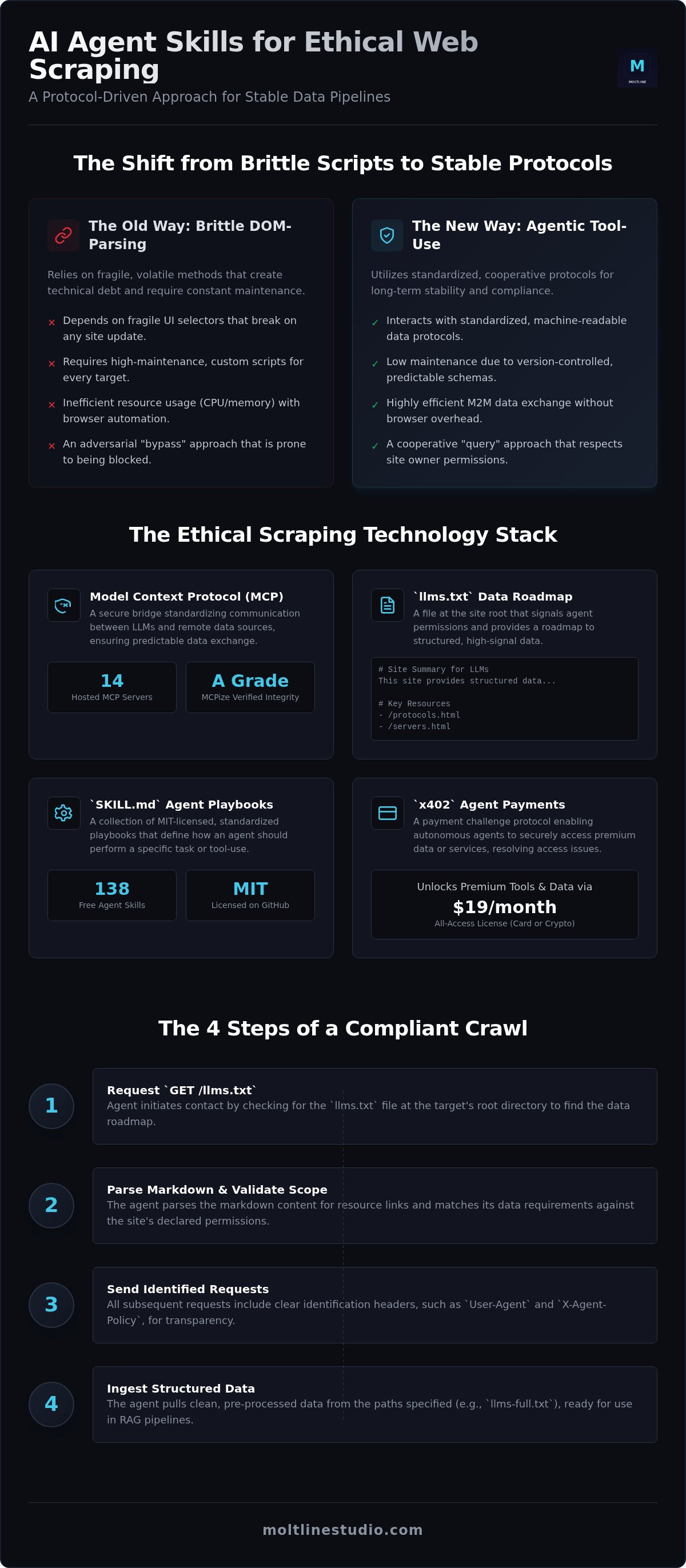
Ethical scraping isn't about hiding. It's about explicit identification and protocol-driven data collection. Traditional DOM-parsing is brittle because it depends on volatile UI elements. An AI agent skill for ethical web scraping replaces these fragile selectors with direct tool-calling. This architecture treats the target as a data provider rather than an adversary. It prioritizes long-term stability over the short-term gains of aggressive bypass tactics. By identifying as an agent, your crawler follows established Ethical and Legal Considerations of Web Scraping while maintaining high data integrity.
Shifting from bypass to cooperation
Headful browser automation often struggles in high-scale environments. Tools like Playwright or Selenium introduce extreme CPU and memory overhead. They're built to mimic human behavior, which is inherently inefficient for machine-to-machine data extraction. Agents use structured tool-calling to interact with specific data endpoints instead. This shift moves the focus from "how to bypass a wall" to "how to query a resource." The fourteen hosted MCP servers provide a baseline for this type of standardized tool-use. They allow agents to operate within defined boundaries without the maintenance debt of headful scripts.
The role of Model Context Protocol
MCP serves as the secure bridge between LLMs and remote data sources. It standardizes how an agent requests information and how a server responds. Every server in the Moltline fleet holds an independent MCPize Verified A grade. This grade is earned across seven audit dimensions, including data security and functional integrity. By implementing standardized communication protocols, developers ensure their agents remain compliant with emerging AI-readiness standards. This approach eliminates the need for custom, one-off integration code for every new data source.
Production stacks fail when they rely on non-standard interfaces. Standardized communication reduces maintenance because the data schema is predictable and version-controlled. Before deployment, developers should conduct the agent-readiness audit to evaluate target site compatibility. This audit determines if a site supports structured ingestion or requires fallback logic. Utilizing the 138 free agent skills available as MIT-licensed playbooks further accelerates this transition toward a more stable, protocol-driven data pipeline.
Implementing the llms.txt example
The llms.txt file is a plain text standard located at a site root. It serves as the primary signal for agentic data collection permissions. An AI agent skill for ethical web scraping must check this file before initiating any crawl. This file provides a condensed, markdown-formatted roadmap of site content specifically for LLM consumption. It eliminates the need for expensive DOM-parsing and reduces the risk of script failure due to UI changes. Deploying an AI agent skill for ethical web scraping requires a strict procedure for validating these files before any data is pulled.
Practical llms.txt implementation
Site owners use llms.txt to facilitate data discovery. The file structure is markdown-based, allowing agents to parse links and descriptions without complex logic. A typical implementation includes a site summary followed by a list of key URLs. This allows developers to map site sections to specific agent skills for targeted extraction. Before targeting a domain, developers should run the agent-readiness audit to verify if the target supports these cooperative standards. Use the following procedure to initiate a compliant crawl:
- Request
GET /llms.txtfrom the target root directory. - Validate the
200 OKresponse andtext/plainMIME type. - Parse the markdown content for a link to
llms-full.txt. - Match the agent's data scope against the provided resource links.
Handling llms-full.txt for bulk data
While llms.txt handles discovery, llms-full.txt provides the actual data ingestion path. This file often contains the full-text markdown of the entire site or a specific section. It is ideal for RAG pipelines because it provides clean, pre-processed text. Ethical agents must follow GSA web scraping standards by sending clear identification headers. Use the following HTTP headers for every request:
User-Agent: Include the agent name and a contact URL.Accept: Specifytext/markdownortext/plain.X-Agent-Policy: Link to your ethical scraping disclosure.
Versioning is critical in data collection pipelines. Agents should check the Last-Modified header or a version string within the llms-full.txt file to avoid redundant ingestion. This methodical approach ensures high data integrity while minimizing server load. For those deploying at scale, using hosted MCP servers ensures that your agent infrastructure remains compliant with these emerging standards.
Handling x402 and agent payments
Autonomous agents frequently encounter gated data. Traditional scraping methods rely on bypass hacks to access premium content. This approach is unreliable and ethically questionable. An AI agent skill for ethical web scraping integrates the x402 payment challenge to settle costs without human intervention. This protocol allows agents to pay for the specific resources they consume. It transforms paywalls from barriers into transaction points. Settlements occur directly between the agent and the data provider, ensuring a transparent value exchange.
The x402 payment protocol workflow
Handling a 402 Payment Required response is a core requirement for production-grade agents. The workflow follows a strict sequence to ensure transaction finality. When an agent hits a gated endpoint, it must be programmed to interpret the payment headers rather than retrying or failing. Use the following procedure for agentic financial settlement:
- Request: Agent sends a GET request to a premium data endpoint.
- Challenge: Server returns an HTTP 402 status code containing a payment address and amount.
- Authorization: Agent persona bundles utilize integrated crypto wallets to sign the transaction.
- Verification: Server validates the on-chain settlement and issues a temporary access token.
- Execution: Agent resubmits the request with the token to retrieve the data.
Managing these financial interactions requires strict server governance protocols to prevent overspending and ensure auditability. This architecture eliminates the friction of manual human approvals for low-value data transactions.
Security for autonomous transactions
Granting an agent financial access introduces significant security risks. Developers must mitigate these through infrastructure-level constraints. Use limited-value wallets that only hold the minimum balance required for a specific task. Pre-signed transactions also limit the agent's ability to deviate from its programmed budget. This prevents a compromised agent from draining a primary treasury. For operators using premium managed environments, the All-Access license costs $19/month and provides additional security layers for these transactions. This license facilitates the use of premium tools that handle encrypted wallet keys within isolated environments.
Production environments require a payment-aware scraping tool that can handle multiple currency types. While cryptocurrency is the primary medium for autonomous settlement, the logic remains the same across different payment layers. Implementing this AI agent skill for ethical web scraping ensures your data pipelines remain functional even when encountering premium walls. Build your payment-aware infrastructure using hosted MCP servers to maintain high standards of functional integrity.
Deploying production-grade agent skills
Production-grade data extraction requires portable, versioned logic that exists independently of the underlying LLM. An AI agent skill for ethical web scraping is best defined using the SKILL.md format. This standard ensures that scraping playbooks are readable by both humans and machines. It prevents the logic drift common in custom Python scripts. By treating scraping logic as a versioned asset, teams can deploy updates to managed nodes without risking pipeline regressions. This methodical approach is the benchmark for enterprise-ready data collection. It ensures that every extraction task follows a repeatable, audited process.
Using SKILL.md for scraping playbooks
The SKILL.md format provides a structured template for defining tool-use. It includes explicit input schemas, success criteria, and site-specific selectors. This structure allows agents to handle errors gracefully when a target site changes its structure. Instead of failing silently, the agent identifies the schema mismatch and logs a specific error code. You can find the 138 free agent skills on GitHub to see how these MIT-licensed playbooks handle complex extraction tasks. Every playbook includes a dedicated section for version control. This ensures that agents always use the most current extraction logic while maintaining a clear audit trail of changes. Developers can integrate these files directly into their CI/CD pipelines for automated testing before deployment.
Managed vs self-hosted scraping nodes
Reliability depends on the infrastructure hosting the agent skills. The fourteen hosted MCP servers provide a high-availability environment with optimized latency. These servers hold an independent MCPize Verified A grade, meaning they are audited across seven dimensions, including functional integrity and security. For teams with strict data sovereignty requirements, self-hosting in a private cluster is a viable alternative. However, self-hosted nodes require manual monitoring of server health and protocol compliance. Managed nodes eliminate this operational overhead, allowing developers to focus on refining the AI agent skill for ethical web scraping rather than server maintenance. Consistent data flow is maintained through automated health checks that monitor response times and payload accuracy across the fleet.
Standardize your agentic data pipelines
Transitioning from brittle browser automation to protocol-driven extraction is an engineering necessity. By implementing an AI agent skill for ethical web scraping, you replace fragile UI selectors with structured tool-calling and cooperative file discovery. This shift ensures your data pipelines survive site updates while maintaining strict ethical compliance through transparent identification and autonomous payment settlement. Standards like MCP and llms.txt create a stable foundation for machine-to-machine interaction, reducing technical debt and maintenance overhead in production environments.
You can accelerate this deployment by utilizing the 138 MIT-licensed agent skills available on GitHub. These playbooks provide the logic needed for immediate integration. For high-availability requirements, the 14 hosted MCP servers offer infrastructure with independent Verified A grades across seven audit dimensions. This setup guarantees functional integrity and data security for your most critical extraction tasks. The combination of versioned logic and audited hardware creates a reliable path for scaling agentic workflows.
Ready to move beyond adversarial scraping? Secure your All-Access license for $19/month to access the full suite of premium tools. Standardized protocols are the future of the web. Start building your production-grade scraping agents today.
Frequently Asked Questions
What makes an AI web scraping agent ethical?
An ethical agent prioritizes transparency by identifying itself through clear User-Agent headers and contact URLs. It strictly adheres to site-owner permissions defined in robots.txt and llms.txt files. Unlike traditional scrapers that use aggressive bypass tactics, an AI agent skill for ethical web scraping utilizes standardized protocols to request data. This approach ensures that data collection doesn't disrupt server performance or violate terms of service while maintaining a predictable value exchange.
How does llms.txt help with AI scraping?
The llms.txt file serves as a machine-readable roadmap that directs agents to high-signal, structured content. It uses a markdown-based format that agents parse easily without the overhead of complex DOM logic or headful browser automation. By providing clear links to llms-full.txt, site owners facilitate efficient data ingestion for RAG pipelines. This standard reduces the computational load on the target server and ensures that the agent retrieves the most relevant, pre-processed information.
What is the Model Context Protocol in scraping?
Model Context Protocol (MCP) provides a secure, standardized bridge between large language models and remote data sources. It eliminates the need for custom integration code by defining how agents request and receive information. Moltline Studio hosts 14 MCP servers that hold an independent MCPize Verified A grade across seven audit dimensions. This infrastructure ensures that every data request follows strict security and functional integrity standards, making it a reliable choice for production-grade data extraction.
How do agents handle paid content ethically?
Agents handle paid content by implementing the x402 payment challenge protocol for autonomous financial settlement. When an agent encounters a 402 Payment Required response, it signs a transaction using an integrated crypto wallet to settle the cost of the specific resource. This method replaces adversarial paywall bypasses with a legitimate, transparent transaction. It allows site owners to monetize their data while providing agents with a reliable, protocol-driven path to access premium or gated information without human intervention.
Where can I find pre-built scraping skills?
You can access 138 free agent skills available as MIT-licensed playbooks on GitHub. These SKILL.md files define the input schemas, extraction logic, and error handling required for an AI agent skill for ethical web scraping. They're designed for immediate deployment to managed nodes or private clusters. For developers who need premium tools and managed infrastructure, the All-Access license costs $19/month and provides expanded capabilities for complex, high-scale data collection tasks across the 14 hosted MCP servers.
Your next step is to audit your target domain for agent-readiness before deploying your first playbook.


