
Effective AI persona security best practices prioritize treating agents as non-human identities with scoped permissions. Securing these architectures requires production-grade protocols like the MCPize Verified A standard to prevent prompt injection and unauthorized tool execution. Establishing verifiable audit trails and using x402 payment challenges ensures agents operate within strict functional and financial boundaries.
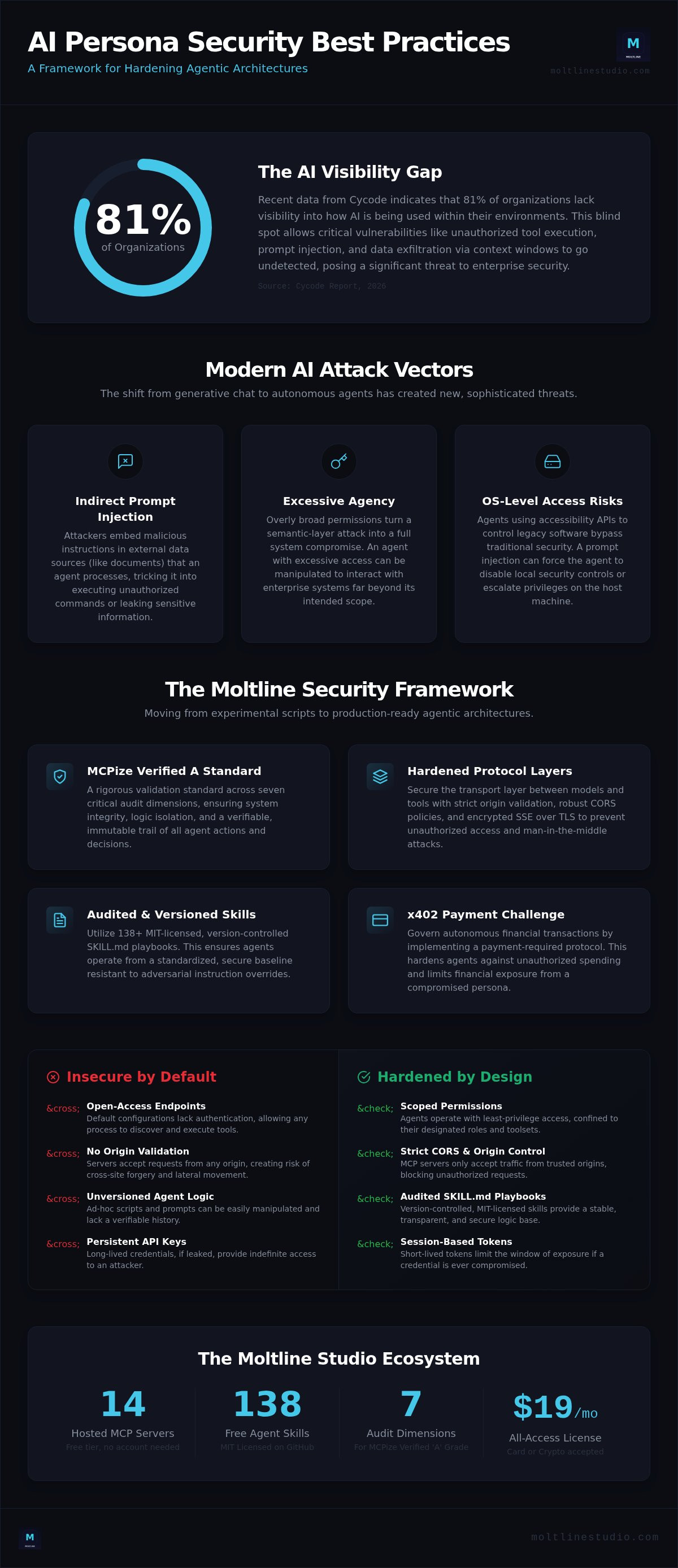
Recent data from Cycode indicates that 81% of organizations lack visibility into how AI is being used within their environments as of 2026. You likely recognize the risk of unauthorized tool execution or data leakage via context windows; standard filters often fail against sophisticated prompt injections. This article provides a technical framework to mitigate these vulnerabilities using the fourteen hosted MCP servers and audited logic. We'll detail how to implement a secure environment, maintain an immutable audit trail, and utilize the 138 free agent skills to standardize operations. By applying these standards, you move from experimental scripts to production-ready agentic architectures. Scoped permissions. Verifiable logs. Hardened endpoints.
Key Takeaways
- Map the transition from generative chat to agentic personas and secure OS-level accessibility APIs against indirect prompt injection.
- Harden the transport layer by implementing strict origin validation and selecting appropriate SSE or stdio protocols for remote agents.
- Audit and version-control SKILL.md playbooks to ensure logic frameworks remain resistant to adversarial instruction overrides.
- Adopt AI persona security best practices by deploying the x402 payment challenge to govern autonomous financial transactions and limit exposure.
- Validate system integrity through the MCPize Verified A standard across seven audit dimensions to maintain a verifiable trail of agent actions.
AI persona security vulnerabilities 2026
The transition from generative chat to agentic persona execution models has redefined the attack surface. LLMs are no longer just text generators; they're system actors with tool-execution capabilities. This shift makes execution integrity the core of AI persona security best practices. When an agent has access to local files or databases, a semantic-layer attack can escalate into a full system compromise. Excessive Agency is now a primary vulnerability where overly broad permissions allow attackers to manipulate enterprise systems through the agent's semantic interface.
Cycode identified CVE-2025-53773 in March 2026, where hidden instructions in pull requests enabled remote code execution via GitHub Copilot. These vulnerabilities bypass network-based DLP because the agent operates locally on the endpoint. Data exfiltration occurs before traffic reaches the perimeter. Persistent context windows also serve as exposure vectors, allowing long-term data leakage of enterprise secrets. Cycode reports that 81% of organizations lack visibility into AI usage as of 2026. New regulations like the Illinois Artificial Intelligence Safety Measures Act, enacted in July 2026, now mandate transparency and incident reporting for these frontier models.
Indirect prompt injection in agentic workflows
Agents ingest untrusted data through Retrieval-Augmented Generation (RAG) and tool calls. Attackers can embed malicious instructions in documents that the agent later processes as valid logic. Without human-in-the-loop oversight, the agent might exfiltrate data or perform unauthorized financial transactions. Use the agent-readiness audit to identify these persona weak points. This is a fundamental requirement for AI safety and operational stability in production environments.
OS-level access and accessibility API risks
Browser-level security cannot protect agents with OS-level access. Personas often use accessibility APIs to control legacy software, creating a path for privilege escalation through unauthorized local process calls. A prompt injection can force an agent to disable local security controls or copy sensitive keys. Secure deployment requires model context protocol servers with strict origin validation. Every server in our ecosystem holds an MCPize Verified A grade across seven audit dimensions to ensure logic isolation. The fourteen hosted MCP servers and 138 MIT-licensed agent skills establish a standardized, secure baseline for developers looking to mitigate these risks.
Hardening model context protocol layers
Securing the transport layer between an AI model and its tools is a technical requirement often overlooked in favor of prompt-level filtering. Default MCP configurations frequently lack the necessary isolation to prevent unauthorized tool discovery. Implementing AI persona security best practices at the protocol level ensures that an agent cannot access system capabilities beyond its defined scope. This requires moving from open-access development environments to production-grade infrastructure with explicit authentication layers. Establishing these boundaries prevents a compromised persona from performing reconnaissance on your internal toolsets.
Origin validation and access control
MCP servers must validate the origin of every incoming request to prevent cross-site request forgery or unauthorized lateral movement. Restricting server access to specific model origins or trusted IP ranges is a fundamental step. When deploying mcp sse transport, you must configure strict CORS policies and custom headers to block untrusted traffic. This approach aligns with Harvard's AI Best Practices for maintaining data integrity and tool containment. Managed environments should utilize session-based authentication tokens rather than persistent API keys to reduce the impact of a potential credential leak. If a token is compromised, the window of exposure is limited to the current execution context.
Secure transport for remote agents
The choice between stdio and SSE (Server-Sent Events) dictates your security posture. Stdio is suitable for local agents where the operating system handles process isolation. Remote personas require SSE over TLS to maintain encrypted communication channels. We maintain the fourteen hosted MCP servers with production-grade encryption to prevent external probes and man-in-the-middle attacks. While strict transport validation adds minor latency, it's a necessary trade-off for professional deployments. You can verify the security of your current setup by following this transport checklist:
- Configure
Access-Control-Allow-Originto match only your specific LLM provider. - Enforce TLS 1.3 for all remote MCP server connections.
- Rotate authentication headers every 24 hours or per session.
- Disable the
list_toolscapability for unauthenticated requests to prevent reconnaissance.
Validating server-side logic ensures that even if a model is compromised via prompt injection, the underlying tools remain protected. Following AI persona security best practices means logic frameworks must be isolated to prevent one agent from discovering the capabilities of another within the same host. If you're building agentic workflows, it's worth reviewing audited MCP infrastructure to see how these layers are implemented in practice to maintain system integrity.
Skill-level security audit checklist
Logic isolation at the protocol layer is insufficient if the agent's core instructions are flawed. The SKILL.md playbook serves as the source of truth for agent behavior and tool interaction. Sanitizing these playbooks is essential to AI persona security best practices. Instruction overrides occur when untrusted user data conflicts with the system prompt. Version control is mandatory for all agent skills. You must track logic changes to identify when a vulnerability was introduced and ensure that no malicious hooks have been injected during updates. Without versioning, a single compromised update can expose your entire data pipeline to unauthorized extraction.
Mandatory audit dimensions for AI skills
Every skill must undergo a rigorous review before deployment in production environments. We utilize the MCPize Verified A grade, which evaluates logic across seven independent audit dimensions. This process includes input sanitization protocols, output validation, and resource limitation. You can review the 138 free agent skills on GitHub to see these standards applied to MIT-licensed playbooks. Rate limiting at the skill level prevents an agent from being used for high-frequency adversarial attacks or unauthorized data harvesting. These constraints ensure that even if a persona is manipulated, its operational impact is confined to a specific, manageable threshold.
Technical Audit Checklist for Personas
Use this numbered procedure to validate any third-party or internal skill before granting system access:
- Verify the MIT license and source integrity of the skill playbook file.
- Test for instruction injection using adversarial prompt sets to ensure logic stability.
- Confirm skill-level data handling complies with local privacy standards and retention rules.
- Validate all tool calls against a strict allow-list to prevent unauthorized execution.
- Audit for hidden telemetry or external hooks that bypass standard logging.
Auditing skills for hidden telemetry prevents silent data exfiltration. If a skill lacks a verifiable audit trail, it remains a liability. Perform an agent-readiness audit to identify potential logic gaps before deployment. You can deploy these playbooks within our audited MCP infrastructure to maintain a hardened execution environment. This setup allows you to track every action against an immutable log, fulfilling compliance requirements for autonomous systems.
Implementing x402 and managed security
Autonomous agents with financial authority present a high-risk vector for Excessive Agency. Traditional fiat payment systems lack the granular challenge-response mechanisms needed to verify an agent's intent before a transaction executes. Applying AI persona security best practices to commerce requires a protocol that treats the agent as a distinct financial actor. Using cryptocurrency allows for the isolation of funds, ensuring an agent only has access to a specific wallet with a pre-defined balance. This architecture prevents a single compromised persona from accessing corporate bank accounts or broad credit lines. Cryptographic signatures. Budget caps. Financial isolation.
Autonomous payment security protocols
The core of agentic commerce is the x402 payment challenge. This protocol requires the agent to solve a cryptographic challenge before any transaction is authorized. It ensures that every expenditure is signed by a verified logic framework rather than an injected prompt. Developers can set strict budget caps and granular spending permissions within the SKILL.md playbook. If an agent attempts to exceed these limits, the transaction fails at the protocol level. This creates a hard boundary for financial exposure in autonomous workflows.
Managed vs. Self-hosted security trade-offs
Self-hosting provides control but often fails at consistent patch management and audit integrity. While our 14 hosted MCP servers offer a free tier for testing, production environments require the stability of a managed infrastructure. An All-Access license costs $19/month and provides premium tools with guaranteed uptime. This model shifts the burden of server-side logic validation and security updates to our audited environment. It's a direct path to production-grade reliability for professional operators.
Managed infrastructure also allows for the use of time-optimized servers. These endpoints reduce latency while maintaining strict transport layer security. Every server maintains an MCPize Verified A grade across seven audit dimensions, ensuring that your production agents operate within a hardened perimeter. Transitioning to these verified environments is the final step in establishing a professional security posture. Verified infrastructure. Immutable logs. Predictable performance.
Frequently Asked Questions
What is the x402 payment challenge?
The x402 protocol is a cryptographic challenge-response system designed to authorize autonomous transactions. It ensures that an agent can only spend funds if it provides a valid signature that matches its pre-defined logic and budget constraints.
Why does Moltline Studio prioritize cryptocurrency for agents?
Cryptocurrency allows for complete financial isolation by using dedicated wallets with fixed balances. This prevents agents from accessing broader corporate credit lines or fiat bank accounts, effectively capping the total financial risk of a compromised persona.
What security benefits does the All-Access license provide?
The $19/month license provides access to premium, audited MCP infrastructure that includes continuous patch management and high-availability endpoints. It moves your agents from a shared free environment to hardened, production-ready servers with enhanced audit logging.
How do I verify the security of a third-party agent skill?
You should check for an MCPize Verified A grade, which audits skills across seven dimensions including data handling and logic isolation. Additionally, you can review the 138 free agent skills on GitHub to see examples of MIT-licensed, audited playbooks.
Do the hosted MCP servers require a credit card for the free tier?
No, the free tier for our 14 hosted MCP servers requires no account, API key, or credit card. You can access these tools directly via their specific URLs for testing and development purposes without any initial financial commitment.
To begin hardening your agentic infrastructure, review the 138 MIT-licensed skills on GitHub and deploy your first audited persona on a hosted MCP server.
Hardening your agentic production stack
Securing autonomous agents requires a shift from simple text filtering to system-level identity management. You must prioritize transport layer encryption, verify skill-level logic through the MCPize Verified A standard, and gate financial actions with cryptographic challenges. Adopting AI persona security best practices ensures that your agents operate within strict functional and financial boundaries. This technical rigor prevents prompt injection from escalating into a full system compromise or unauthorized expenditure.
Managed infrastructure provides the most efficient path to these security benchmarks. Our 14 hosted MCP servers integrate the x402 payment challenge natively, allowing you to govern agentic commerce with precision. You don't have to manage manual security patches or logic validation alone. Secure your production stack with an All-Access license to access audited tools and time-optimized endpoints. Building safe, autonomous systems is a complex engineering task, but it's entirely achievable with the right protocols.
Frequently Asked Questions
How do I prevent prompt injection in MCP servers?
Prevent prompt injection by implementing strict origin validation and input sanitization at the server level. You must restrict server access to specific model origins and trusted IP ranges. Implementing the MCPize Verified A standard ensures logic isolation. Every one of the 14 hosted MCP servers in our ecosystem holds this grade across seven dimensions. This prevents injected instructions from escaping the context window and executing unauthorized tools on the host system. Logic isolation. Input sanitization. Hardened boundaries.
What are the seven dimensions of an MCPize Verified A grade?
The MCPize Verified A grade evaluates logic frameworks across seven independent audit dimensions: input sanitization, output validation, resource limitation, transport security, logic isolation, audit trail integrity, and credential handling. These standards ensure that AI persona security best practices are maintained throughout the agentic lifecycle. Every one of the 14 hosted MCP servers at Moltline Studio maintains this independent grade to ensure production-grade reliability for professional developers and operators looking for stable deployments.
Are MIT-licensed AI skills safe for enterprise production?
MIT-licensed skills are safe for production if they undergo rigorous auditing and version control. Our 138 free agent skills on GitHub are audited under the MCPize standard to prevent hidden telemetry or malicious hooks. Enterprises should always verify the source integrity of the SKILL.md playbook before deployment. Hardened skills provide a transparent logic framework that is more predictable than proprietary, black-box agentic behaviors. This transparency is a core component of professional security and long-term maintenance.
How does the x402 protocol secure autonomous agent payments?
The x402 protocol secures payments by requiring agents to solve a cryptographic challenge before any transaction is authorized. This mechanism ensures that expenditures are signed by a verified logic framework rather than a manipulated prompt. By integrating x402, you can set strict budget caps and granular spending permissions. This reduces financial exposure by isolating funds within dedicated cryptocurrency wallets, effectively preventing unauthorized access to broader corporate bank accounts or credit lines. Cryptographic verification. Budget enforcement. Financial isolation.
What is the difference between SSE and stdio transport security?
Stdio transport relies on the host operating system for process isolation and is best for local agents. Server-Sent Events (SSE) over TLS provide encrypted communication channels for remote agents, protecting against man-in-the-middle attacks. While SSE adds minor latency, it is essential for professional AI persona security best practices when deploying across distributed networks. Managed servers utilize SSE to maintain strict transport layer security and origin validation. Encrypted channels. Process isolation. Verified transport protocols.
To begin hardening your agentic infrastructure, review the 138 MIT-licensed skills on GitHub and deploy your first audited persona on a hosted MCP server.


