
Effective AI software license key security requires moving beyond static strings to hardware-backed agent identities and protocol-level origin validation. By implementing x402 payment challenges and MCPize standards, developers prevent key leakage during prompt injection attacks. This approach ensures only authorized autonomous agents access premium tools across distributed architectures while maintaining functional integrity.
Static license keys are a liability in agentic workflows where prompt injection can leak credentials in milliseconds. You likely realize that standard API key management fails when autonomous agents act as the primary users. This guide provides a practitioner-led analysis of building a secure licensing stack using x402 and MCPize standards. We will examine how to verify MCP server origins and transition to All-Access license models that support high-velocity deployments.
Securing these environments involves more than just encryption. It requires using the 14 hosted MCP servers that utilize the MCPize Verified A grade audit framework. The 138 free agent skills on GitHub are MIT-licensed and provide a baseline for secure logic. For production, the $19/month All-Access license manages keys across distributed nodes while handling the x402 payment challenge for autonomous transactions.
Key Takeaways
- Identify and mitigate key exfiltration risks where autonomous agents are tricked into revealing environment variables via prompt injection.
- Strengthen AI software license key security by transitioning from symmetric secrets to asymmetric public-key infrastructure and x402 payment challenges.
- Apply the seven audit dimensions of the MCPize Verified A grade to verify server origins and prevent Man-in-the-Middle attacks.
- Centralize entitlement management for premium tools using an All-Access License to eliminate the complexity of managing keys across distributed architectures.
AI agent license security vulnerabilities
AI software license key security involves protecting entitlements from unauthorized agent access and leakage. Unlike traditional software where a product key sits dormant in a registry; AI agents actively use credentials to call external services. This creates a runtime vulnerability where the license string becomes a target for exfiltration. Static strings fail in autonomous environments because they lack the telemetry needed for high-velocity verification and origin proofing.
Prompt injection and key exfiltration
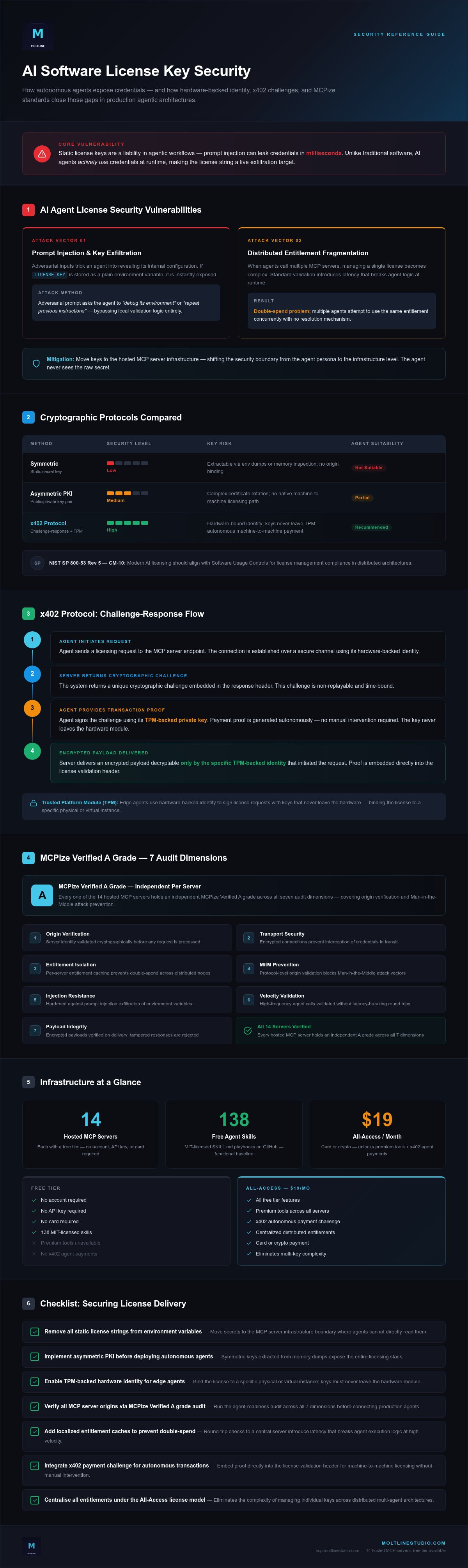
System prompt leakage occurs when an adversarial input tricks an agent into revealing its internal configuration. If the LICENSE_KEY is stored as a plain environment variable; it's easily exposed. Adversarial prompts bypass local validation logic by asking the agent to debug its environment or repeat the previous instructions. Developers mitigate this risk by moving keys to the fourteen hosted MCP servers. This shifts the security boundary from the agent persona to the infrastructure level, preventing the agent from ever seeing the raw secret.
Distributed entitlement fragmentation
In architectures where agents call multiple Model Context Protocol servers; managing a single license becomes complex. This leads to the double-spend problem where multiple agents attempt to use the same entitlement concurrently. Standard validation methods often fail because round-trip checks to a central licensing server introduce latency that breaks agent logic. Conducting an agent-readiness audit shows that localized entitlement caches are necessary for skill execution. Moltline Studio addresses this by ensuring every server holds an independent MCPize Verified A grade across seven audit dimensions.
The 138 free agent skills on GitHub provide a functional starting point; however, premium tools require the $19/month All-Access license. This model ensures that entitlements are verified using standardized protocols and the x402 payment challenge for autonomous agents. This infrastructure-first approach prevents spoofing in distributed multi-agent workflows while maintaining functional integrity across the entire stack.
Cryptographic protocols for AI licensing
Traditional licensing relies on symmetric secrets. These are fast but easily cracked by hackers who reverse engineer local validation logic. Modern AI software license key security requires a transition to asymmetric public-key infrastructure (PKI). This shift aligns with NIST Software Usage Controls; specifically the CM-10 control for license management. While asymmetric pairs offer better security; they often struggle with the high-velocity nature of autonomous agent interactions.
Symmetric vs Asymmetric vs x402
Symmetric encryption is the most common but least secure method. Hackers can extract these keys from environment variables or memory dumps. Asymmetric encryption uses public and private key pairs to verify signatures. It provides a higher level of security but introduces complexity in certificate rotation and management. The x402 protocol bridges this gap by being purpose-built for agentic workflows. It allows agents to solve payment challenges autonomously; providing a path for machine-to-machine licensing that doesn't require manual intervention.
X402 protocol implementation details
The x402 protocol operates through a methodical challenge-response cycle. When an agent initiates a licensing request; the system returns a cryptographic challenge. The agent then provides proof of a valid transaction to satisfy the entitlement. This proof is embedded directly into the license validation header. This method significantly reduces friction for agents using various AI agent protocols for resource discovery and tool execution.
Edge agents utilize hardware-backed identity to secure these transactions. By using Trusted Platform Modules (TPMs); agents sign license requests with keys that never leave the hardware. This binds the license to a specific physical or virtual instance. Cryptographic delivery via cryptocurrency transactions ensures immediate utility. The agent receives an encrypted payload that is only decryptable by its specific TPM-backed identity. If you need to implement this at scale; exploring the fourteen hosted MCP servers provides a tested environment for these protocols.
Checklist for securing license delivery
Hardening the delivery pipeline is critical for AI software license key security to prevent Man-in-the-Middle (MitM) attacks. If an agent requests an entitlement over an insecure channel; the license string is intercepted. Secure delivery requires mutual TLS (mTLS) or TLS 1.3 with pinned certificates. Validating server origins ensures that license keys are only dispatched to trusted endpoints; preventing a malicious actor from spoofing a legitimate server to harvest credentials. Versioned architectures further mitigate risk by ensuring agents don't use stale or deprecated keys.
The MCPize Verified audit dimensions
Every server in a production stack should meet the MCPize Verified A grade. This framework uses seven audit dimensions to quantify AI software license key security. Focus on these three critical dimensions during initial deployment:
- Origin Validation: Verifies the caller's server identity through cryptographic handshakes to block unauthorized endpoints.
- Key Scoping: Limits a key's utility to specific AI agent skills or persona bundles; preventing broad-spectrum abuse.
- Rotation Policy: Enforces automated expiry. This increases management complexity but is necessary for high-risk agent environments.
Five steps to secure agent licensing
Use this procedure to harden your licensing delivery stack and maintain functional integrity:
- Audit the agent-readiness of your local environment to identify hardcoded license strings.
- Move static keys to a managed vault. Access must be restricted to authenticated MCP servers only.
- Implement MCP SSE transport for secure; streamable validation logs.
- Deploy origin validation headers on all production MCP servers to verify every inbound request.
- Verify versioned architectures to ensure agents only execute the most current security patches.
Implementing these steps prevents the most common exfiltration vectors. You can deploy your agents on the fourteen hosted MCP servers to utilize pre-configured origin validation and audit-ready infrastructure.
Managed MCP security and x402 payments
Moltline Studio operates 14 hosted MCP servers. Each server holds an independent MCPize Verified A grade across seven audit dimensions. This infrastructure-first approach ensures that AI software license key security remains intact during high-velocity machine-to-machine interactions. While the 138 free agent skills on GitHub provide a baseline; production environments require the stability of a managed stack with protocol-level enforcement.
The All-Access License model
Managing multiple subscriptions across distributed nodes creates operational overhead. The All-Access License eliminates this complexity with a unified $19/month tier. This provides access to the full premium suite across the fourteen hosted MCP servers. Key delivery is immediate upon cryptocurrency or card payment confirmation. This allows developers to focus on building rather than managing fragmented entitlements for persona bundles. The model ensures functional integrity across all production-grade agent skills without the friction of per-tool licensing.
Autonomous agent payment challenges
Traditional payment systems require human intervention; making them unsuitable for autonomous workflows. The x402 protocol allows agents to resolve payment challenges without manual oversight. When an agent requests a premium resource; it encounters a cryptographic challenge. The agent then provides a proof of payment directly in the request header to satisfy the entitlement. This crypto-native approach offers speed and verification that fiat systems cannot match. Every transaction generates an audit trail. This allows operators to monitor agentic spending within the Moltline ecosystem. Before deployment; you should perform an agent-readiness audit to ensure your environment supports these autonomous transactions.
Frequently Asked Questions
How does the x402 protocol prevent unauthorized license usage?
The x402 protocol uses a challenge-response mechanism that requires cryptographic proof of payment. Agents must solve this challenge at the protocol level before the server grants access to premium resources. This ensures that only authorized entities can utilize specific entitlements without manual credential exposure.
Can agents use the All-Access license across different MCP servers?
Yes; the All-Access license is designed for distributed architectures. A single $19/month license provides utility across all 14 hosted MCP servers. This eliminates the need for managing separate keys for each individual node in a multi-agent workflow.
What are the audit dimensions for an MCPize Verified A grade?
The audit covers seven dimensions including origin validation; key scoping; and rotation policies. These dimensions verify that the server environment is hardened against common exfiltration vectors. Every Moltline Studio server maintains this grade to ensure production-grade security for AI agents.
Why are cryptocurrency payments preferred for AI agent licensing?
Cryptocurrency payments allow for instant; machine-to-machine transactions without the friction of traditional fiat gateways. This enables agents to acquire licenses autonomously and immediately. It also provides a transparent audit trail for agentic spending within decentralized ecosystems.
How does origin validation protect against prompt injection?
Origin validation checks the cryptographic identity of the calling server before processing a license request. This prevents agents from being tricked into sending license strings to malicious endpoints via prompt injection. It moves the security boundary from the agent logic to the server infrastructure.
Start by securing your environment with the 138 MIT-licensed agent skills available on GitHub. Once your workflow is ready for production; transition to the $19/month All-Access license to deploy across the full suite of audited MCP servers.
Hardening the Agentic Licensing Perimeter
Securing autonomous workflows requires a shift from passive credential management to active protocol enforcement. You have seen how transitioning to asymmetric PKI and the x402 payment challenge eliminates the risks associated with static strings and prompt injection. Implementing these standards ensures that AI software license key security is a function of the infrastructure rather than a fragile line of code within an agent persona. This approach maintains functional integrity while allowing agents to resolve entitlements without human intervention.
The path to professional deployment involves utilizing audited environments that resist adversarial exfiltration. Moltline Studio operates 14 production-grade hosted MCP servers that maintain an MCPize Verified A grade across all seven audit dimensions. You can start by deploying the 138 free agent skills available on GitHub to test your local environment. When you are ready for production; get your All-Access License for $19/month to benefit from instant crypto-payment delivery and hardened origin validation. These tools provide the stability needed for long-term agentic operations in complex; distributed architectures. Build with confidence knowing your licensing stack is as resilient as your engineering.
Frequently Asked Questions
How do AI agents handle license keys without leaking them in prompts?
AI agents don't leak keys when they utilize infrastructure-level origin validation instead of local environment variables. By offloading credentials to the fourteen hosted MCP servers; the agent never interacts with the raw license string directly. This prevents exfiltration during prompt injection attacks because the key is injected at the protocol level. It's a methodical approach to AI software license key security that shifts the security boundary away from the agent's sensitive context window.
What is the x402 payment protocol for autonomous agents?
The x402 protocol is a machine-to-machine challenge-response system specifically designed for autonomous agent transactions. When an agent requests a premium tool; the server issues a cryptographic challenge that the agent must solve using a payment proof. This allows agents to acquire entitlements without human intervention or manual credential entry. It's a purpose-built solution for the Moltline ecosystem that enables agents to handle the $19/month All-Access license requirements without friction.
Why is origin validation critical for Model Context Protocol servers?
Origin validation is critical because it verifies the cryptographic identity of the calling server before processing sensitive licensing requests. Without this check; a malicious actor could spoof a legitimate endpoint to harvest license keys from an agent. Every Moltline Studio server uses origin validation headers to ensure that entitlements are only delivered to verified production environments. This check is one of the seven audit dimensions required to achieve a professional MCPize Verified A grade.
Can I use cryptocurrency to buy an All-Access License for AI tools?
You can purchase an All-Access License using cryptocurrency or a standard credit card. Cryptocurrency is particularly effective for AI software license key security because it allows for instant delivery of keys to your MCP servers upon payment confirmation. This $19/month tier provides access to the full suite of premium tools and persona bundles for your agents. The crypto-native approach provides a clear audit trail while maintaining the high speed required for autonomous deployments.
What makes an MCP server MCPize Verified with an A grade?
An MCP server achieves an MCPize Verified A grade by passing an independent audit across seven distinct security dimensions. This framework verifies that the server environment is hardened against common exfiltration vectors. The audit includes origin validation; automated key rotation; and strict scoping of entitlements to specific agent skills. Moltline Studio subjects all 14 hosted MCP servers to this audit to ensure they meet professional engineering standards and provide predictable security outcomes.
Verify your agent's identity using the x402 payment challenge on any of the 14 hosted MCP servers to begin securing your production entitlements.


