
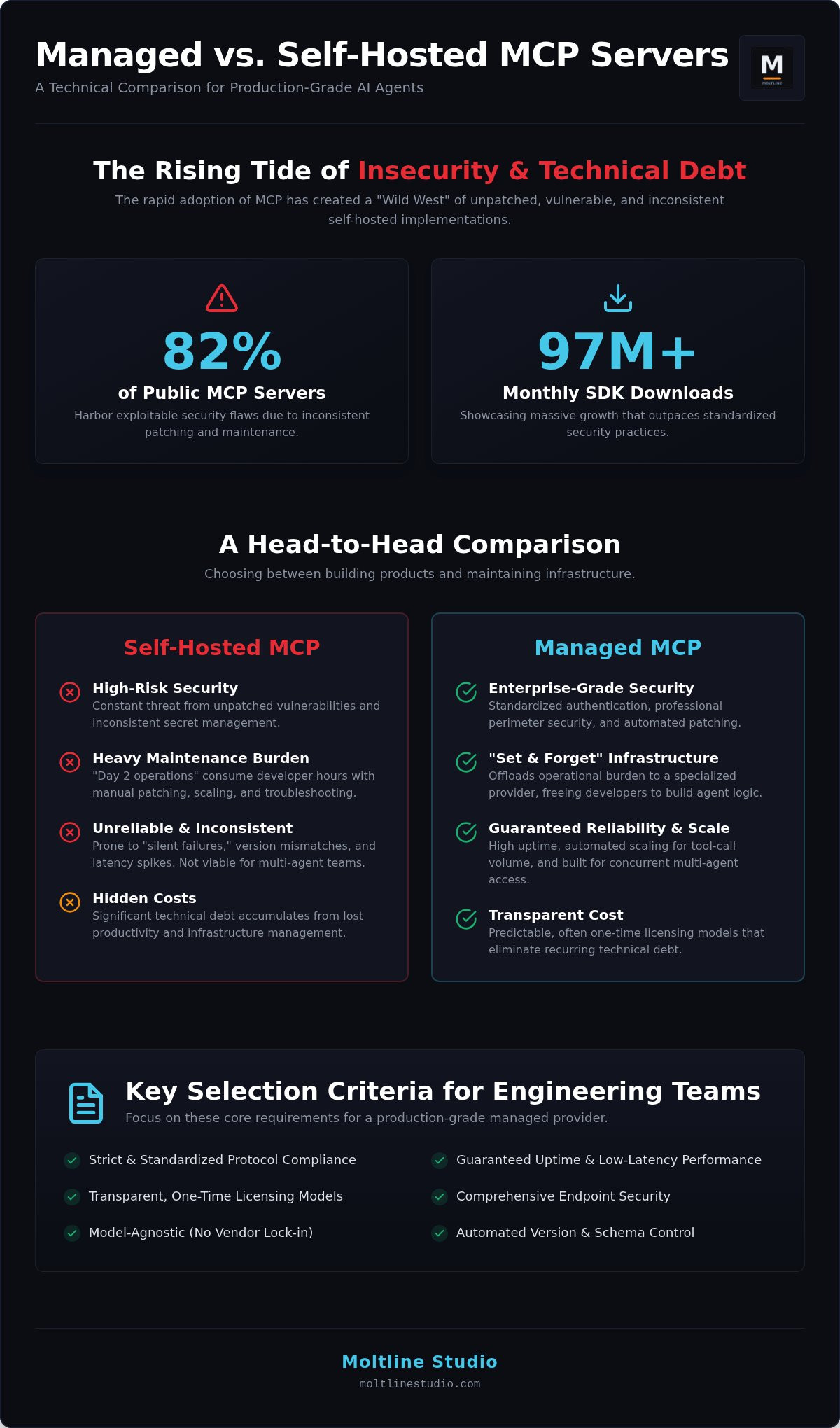
Independent security scans reveal that up to 82% of public MCP servers harbor exploitable flaws. This vulnerability gap persists even as MCP SDK downloads reached 97 million monthly by March 2026. For engineering teams, the decision to use managed MCP servers versus self-hosting is no longer a matter of preference. It's a choice between building products and maintaining infrastructure. Standardization is the only way to avoid the current 'Wild West' of unpatched implementations.
You're likely familiar with the friction of self-hosted environments. Constant patching, manual scaling, and unexpected latency spikes create significant technical debt. This guide evaluates the trade-offs between managed and self-hosted MCP infrastructure to help you build stable, production-ready AI agents. We'll analyze the high cost of in-house maintenance, the security advantages of standardized protocols, and the path to guaranteed uptime for your agentic tools. We prioritize functional integrity over marketing hype to ensure your agents remain reliable in professional production environments.
Key Takeaways
- Understand why Day 2 operations for self-hosted environments often lead to workflow failure and how managed MCP servers mitigate these infrastructure risks.
- Identify the core requirements for production-grade environments, including standardized authentication management, version control, and endpoint security.
- Evaluate the performance trade-offs between local execution and professional perimeter security to ensure low-latency agentic workflows.
- Establish technical selection criteria for engineering teams, focusing on strict protocol compliance and transparent, one-time licensing models.
- Learn how an All-Access License eliminates recurring technical debt by providing instant access to a specialized catalog of tested AI agent skills.
The Shift to Managed MCP Servers: Why Self-Hosting Is Becoming Technical Debt
The Model Context Protocol (MCP) transitioned from an experimental framework to a core production requirement in early 2026. This evolution reflects a fundamental move from prompt-based interactions to tool-augmented agentic systems. Agents no longer rely solely on internal weights. They require persistent, reliable access to external data and logic frameworks. As organizations move these systems into production, the infrastructure supporting these connections must meet enterprise-grade standards. For many, this means a strategic pivot toward managed MCP servers to ensure long-term operational integrity.
Building a basic MCP server is straightforward. Maintaining it is not. Engineering teams often underestimate "Day 2 operations," which involve the ongoing management of infrastructure after the initial deployment. Self-hosted setups frequently succumb to workflow failures caused by unpatched vulnerabilities or version mismatches. This is essentially a managed hosting service model applied to AI agent connectivity. It offloads the operational burden of security patches and versioning to specialized providers. Without this offloading, the hidden costs of manual maintenance quickly accumulate into significant technical debt.
The Burden of Self-Hosted Infrastructure
Consistency is the primary casualty of self-hosted MCP environments. Handling tool definition updates across multiple agent instances creates immediate friction. When a schema changes, every local instance requires a manual update. This process is prone to human error. Managing environment variables and secrets across disparate local setups lacks the rigor required for secure production. Local hosting models fail when scaling to multi-agent teams. They cannot provide the concurrent access or standardized protocols necessary for collaborative agentic workflows. Technical debt isn't just about code. It's about the hours lost to infrastructure troubleshooting.
Reliability as a Production Standard
Critical AI agent skills require high uptime. A failed connection to a database or a documentation repository renders an agent useless. In unmonitored self-hosted managed MCP servers, "silent failures" are common. A server process might crash without triggering an alert. The agent then receives null responses or times out, leading to degraded performance or hallucinations. Production environments demand a "set and forget" infrastructure mindset. Developers should focus on agent logic and skill refinement rather than server uptime. Reliability must be a baseline standard, not a variable that depends on a developer's local machine configuration.
Defining Managed MCP Infrastructure: More Than Just Hosting
Managed MCP servers are standardized, third-party hosted endpoints that expose tools to AI agents via the Model Context Protocol. This infrastructure provides more than simple storage or compute. It creates a pre-configured, tested environment where agent tools reside. These servers act as the critical bridge between Large Language Models (LLMs) and external data sources. While prompt-based agents are limited by their context window, tool-augmented systems use managed infrastructure to interact with real-world databases and APIs in real time. This setup ensures that the agent's capabilities are limited only by the tools it can access, not the environment it's running in.
A major distinction exists between open managed hosting and proprietary cloud-locked services. Some providers tie their protocol implementations to specific cloud databases. For example, Google Cloud's managed MCP servers focus on integrating with their internal database ecosystem to power agentic workflows. True managed infrastructure should remain model-agnostic. It should support Claude, GPT-4o, or any other LLM that adheres to the protocol. This prevents vendor lock-in and allows engineering teams to swap underlying models without rebuilding their entire tool library.
Core Architecture of a Managed Server
Standardized protocol implementation is the foundation of a managed environment. It ensures immediate compatibility with major LLM providers. These servers utilize automated scaling to handle fluctuating tool-call volumes. When an agent initiates a complex sequence of data retrievals, the infrastructure scales to prevent latency spikes. This level of responsiveness is difficult to maintain in self-hosted setups. It requires precise resource allocation and load balancing that managed providers handle as a baseline service. For teams looking to deploy immediately, accessing a catalog of tested MCP servers can bypass these architectural hurdles.
Security and Integrity Layers
Security in a managed context is about more than just a firewall. It involves injection-safe tool definitions and rigorous adversarial testing protocols. These measures ensure that an agent cannot be manipulated into executing unauthorized commands. Managed servers also handle authentication through OAuth or API keys without adding developer overhead. This removes the risk of hard-coded credentials in agent scripts. Versioned skill architectures further enhance stability. They allow teams to roll back updates if a new tool definition causes unexpected agent behavior. This systematic approach to integrity is what separates professional production environments from experimental local scripts.
Managed vs. Self-Hosted MCP Servers: A Performance and Security Comparison
Self-hosting is often positioned as the "zero-cost" entry point for developers. This perspective ignores the cumulative operational overhead required for production stability. Choosing between local infrastructure and managed MCP servers requires a cold analysis of latency, security, and total cost of ownership. While local setups provide immediate data proximity, they lack the robust perimeter defense and parallel processing capabilities of professional hosting environments.
The choice between these models often comes down to the "SaaS Tax" versus the "Maintenance Tax." The SaaS Tax refers to recurring subscription fees that scale with usage, common among cloud-locked providers. The Maintenance Tax is the cost of engineering hours spent on dependency management, security patches, and environment troubleshooting. In-house maintenance for custom MCP builds can consume significant resources, often far exceeding the cost of a one-time license or a managed endpoint. For teams prioritizing long-term production stability, eliminating the maintenance-induced staccato of self-hosting is essential.
Performance Benchmarks for Agentic Workflows
Latency is the primary bottleneck in agentic systems. Local execution offers near-zero network lag, but it suffers from compute bottlenecks when running complex tool-call sequences. Managed cloud endpoints introduce network overhead, yet they provide superior parallelization. An independent review of managed MCP platforms highlights that performance varies significantly based on transport protocols. Cold start issues are frequent in serverless MCP implementations, where the first tool call can take seconds to initialize. Dedicated managed hosting avoids this by maintaining warm instances, ensuring low-latency responses for real-time automation.
Security Posture Comparison
Security in a self-hosted environment is a reactive process. Many public MCP servers are deployed with exploitable flaws, and between 47% and 53% of organizations have experienced incidents where AI agents exceeded their permissions. Managed providers mitigate this risk through mandatory credential rotation and strict tool isolation. They use injection-safe definitions to prevent adversarial prompts from executing unauthorized system commands. Tested AI agent skills are fundamentally superior to raw, unvalidated prompt templates. They provide a standardized layer of logic that prevents "silent failures" and permission creep, ensuring the agent operates within defined functional boundaries.
Scalability remains a hard limit for self-hosted, Docker-based MCP implementations. While Docker provides containerization, it doesn't solve the problem of horizontal scaling across multi-agent production teams. As tool-call volume increases, local resources saturate. This leads to dropped connections and degraded agent performance. Managed MCP servers utilize elastic infrastructure to handle these spikes, providing a consistent experience regardless of the number of concurrent agents in the field.
Selecting a Managed MCP Provider: Key Criteria for Engineering Teams
Engineering teams must prioritize protocol compliance. A provider must strictly follow official MCP specifications to ensure model-agnostic utility. If a server is locked to a specific cloud vendor's database, it's not a protocol. It's a proprietary connector. Evaluate managed MCP servers based on their ability to integrate with Claude, GPT-4o, and specialized agent frameworks without code modification. Catalog depth is a secondary but vital metric. Pre-built Persona Bundles and AI Agent Skills allow for immediate deployment. This avoids the time-intensive process of writing tool definitions from scratch.
Evaluating the Licensing Model
The industry is shifting toward one-time AI tool licenses to ensure long-term production stability. This model eliminates the recurring "SaaS Tax" discussed in previous sections. Recurring usage-based fees create "billing surprises" that complicate budget forecasting for engineering departments. Consumption-based models often penalize successful scaling. By contrast, a one-time license ensures that infrastructure costs remain flat even as agentic volume increases. Crypto-native payments facilitate this by providing instant global access and immediate license key delivery. This bypasses the friction of traditional fiat procurement and allows for rapid stack assembly.
Technical Support and Documentation
Time-to-first-tool-call is the primary metric for developer experience. Clear, staccato documentation is a requirement for rapid deployment. Providers must offer versioned templates and standardized "skills.md" files. These files act as the manifest for the agent's capabilities, defining exactly what the tool can and cannot do. A functional "free tier" is necessary for initial technical validation. It allows engineers to test protocol compliance and latency before committing to a production-grade license. Documentation should focus on functional integrity and security boundaries rather than marketing promises. Professional teams require tools that are tested under adversarial conditions to prevent permission creep.
Eliminate the engineering-first staccato of maintenance by choosing a provider that prioritizes substance over aesthetics. Access a specialized catalog of production-grade MCP servers to secure your agentic infrastructure today.
Scaling with Moltline: Managed MCP Servers for Production-Grade Agents
Moltline Studio adopts a grounded, engineering-first perspective to solve the infrastructure instability of self-hosted tools. By providing managed MCP servers that are pre-configured and rigorously tested, we eliminate the operational staccato that plagues unmonitored local environments. Production teams require tools that perform under adversarial conditions. Our approach prioritizes functional integrity over aesthetic promises. We ensure that every server in our catalog meets the technical standards required for professional deployment. This allows builders to bypass the maintenance-induced debt discussed in previous sections and move directly to agentic execution.
Getting started with professional infrastructure should not involve procurement delays. Our delivery pipeline is designed for speed and technical transparency. We utilize cryptocurrency payments to facilitate instant global access. Once the transaction is verified on the blockchain, the system provides instant license key delivery. This crypto-native workflow reflects our commitment to efficiency. It bypasses the friction of traditional fiat systems and monthly subscription approvals. You get the tools you need exactly when the engineering requirements demand them.
Moltline Studio’s Managed MCP Catalog
Access a specialized catalog of Persona Bundles and AI Agent Skills designed for immediate utility. These aren't raw, unvalidated prompt templates. They are versioned, logic-driven tools that integrate seamlessly into existing Claude or LangChain workflows. We use standardized protocol implementations to guarantee compatibility across the major LLM ecosystems. Production readiness is achieved through rigorous testing of schema definitions and transport layers. This systematic approach ensures that your agents have a reliable bridge to external data. Developers can focus on refining agent logic rather than debugging endpoint connectivity or patching local Docker containers. Our catalog is built to scale with your multi-agent production teams without performance degradation.
The Integrity of One-Time Licensing
The All-Access License model is built for long-term production stability. It eliminates the recurring friction of monthly SaaS billing for critical infrastructure. Once you acquire a license, you maintain full operational control via a lifetime license key. This model respects the engineering budget by removing the "billing surprises" associated with consumption-based cloud hosting. Your costs remain predictable regardless of how many tool calls your agents execute. This is a direct response to the "Maintenance Tax" that often cripples self-hosted projects over time. By choosing managed MCP servers through a one-time licensing model, you secure your stack against future price hikes or service tier changes. Join a community of builders who value functional integrity, substance, and predictable outcomes over marketing hype.
Deploying Resilient Agentic Infrastructure
The transition from experimental scripts to production-grade AI agents requires a fundamental shift in infrastructure strategy. Self-hosting often introduces a Maintenance Tax that consumes engineering hours and destabilizes workflows through unpatched vulnerabilities. Choosing managed MCP servers provides a standardized environment where security, latency, and protocol compliance are handled as baseline requirements. This allows your team to focus on agent logic rather than the constant staccato of server maintenance. Reliability in 2026 depends on standardized, tested endpoints that prevent permission creep and silent failures.
Moltline Studio provides a specialized catalog of production-grade, injection-safe tool definitions to secure your agentic stack. Our model eliminates the friction of recurring monthly subscriptions. You'll receive instant digital delivery of license keys through a one-time crypto payment. This ensures long-term operational control and predictable costs for your engineering team. Purchase an All-Access License for Managed MCP Servers to stabilize your production environment today. Build your agentic tools on a foundation of functional integrity and technical transparency.
Frequently Asked Questions
What is the primary advantage of a managed MCP server over self-hosting?
The primary advantage is the elimination of the engineering-first staccato of maintenance. Managed environments offload the operational burden of patching, scaling, and endpoint monitoring to specialized providers. This ensures that agentic workflows remain stable without the technical debt associated with local Docker environments. It transforms infrastructure from a variable liability into a fixed, reliable asset for production teams.
How do managed MCP servers handle security and tool injection risks?
Managed providers utilize injection-safe tool definitions and rigorous adversarial testing protocols to prevent unauthorized command execution. They implement mandatory credential rotation and strict tool isolation as baseline security standards. This approach mitigates the risk of permission creep, which affects approximately 50% of organizations using AI agents in production. Professional perimeters provide a level of security that unvalidated, local prompt templates cannot match.
Can I use managed MCP servers with any LLM, or am I locked into Claude?
Managed MCP servers are model-agnostic by design. While the protocol was popularized alongside Claude, any LLM that adheres to the Model Context Protocol specifications can interface with these endpoints. This includes GPT-4o and various open-source agent frameworks. This vendor neutrality prevents vendor lock-in, allowing developers to swap underlying models without re-engineering their entire library of AI agent skills or persona bundles.
What is the difference between a managed MCP server and a standard API?
A standard API provides a stateless endpoint for specific data retrieval. A managed MCP server provides a standardized transport layer that allows an LLM to discover and use tools contextually. It includes schema definitions that tell the agent exactly how to interact with the underlying logic. This protocol-based approach enables agentic systems to understand tool capabilities dynamically rather than relying on hard-coded API calls within a script.
How does the licensing model work for Moltline managed servers?
Moltline Studio uses an All-Access License model paid via cryptocurrency. This eliminates the friction of monthly SaaS subscriptions and recurring billing cycles. Once the crypto transaction is verified, you receive instant digital delivery of your license key. This one-time payment provides lifetime access to a specialized catalog of production-grade tools. It ensures that your infrastructure costs remain predictable even as your agentic volume scales.
Is it possible to migrate from a self-hosted MCP setup to a managed one?
Migration is straightforward because the Model Context Protocol is a standardized specification. If your self-hosted tools follow official MCP standards, they can be transitioned to a managed endpoint with minimal configuration changes. The primary task involves updating the server transport URL and authentication headers in your agent configuration. This process allows teams to move from unstable local setups to production-ready infrastructure without rebuilding their tool logic.
What happens if my managed MCP provider goes offline?
Professional providers utilize redundant, elastic infrastructure to ensure high availability. If a primary endpoint fails, traffic is typically routed to a failover instance to maintain agent uptime. This level of reliability is difficult to achieve with self-hosted setups on local hardware. For critical production environments, choosing a provider with a "set and forget" infrastructure mindset is essential to prevent the silent failures common in unmonitored environments.
Do I need to be an expert in the Model Context Protocol to use a managed server?
You don't need to be a protocol expert to deploy managed infrastructure. Managed MCP servers provide pre-configured, tested environments that handle the complex transport and transport layer details for you. Developers only need to connect their agent to the provided endpoint using standard license keys. This approach allows teams to deploy production-grade AI agent skills immediately, bypassing the steep learning curve required to build and secure custom servers from scratch.


