
Effective mcp server origin validation requires checking the `Origin` header against a whitelist of trusted AI clients during the SSE handshake. By rejecting requests from unauthorized domains, developers prevent cross-site request forgery and Confused Deputy attacks. This security layer is essential for servers exposed over the internet via HTTP rather than local stdio transports.
Exposing an AI toolset to the public internet without strict origin checks is like leaving your database credentials in a public repository. You likely understand that while local stdio transports are safe by default, the shift to stateless architecture in the July 2026 MCP specification demands explicit security controls. This guide provides a technical reference for implementing these checks to protect your sensitive tools from malicious cross-origin calls. You'll learn to configure headers correctly, handle preflight requests, and meet the audit requirements for the agent-readiness audit. We will examine specific implementation details for the 14 hosted MCP servers at Moltline Studio, which mandate TLS 1.3 for all connections. Following these steps ensures your 138 free agent skills remain secure while accessible to authorized autonomous agents. If you require advanced capabilities, an All-Access license provides pre-hardened tools ready for immediate deployment.
Key Takeaways
- Implement mcp server origin validation to block unauthorized web-based AI clients from accessing sensitive tools through the user's browser.
- Secure the initial SSE handshake by verifying the Origin header against a whitelist defined in your server configuration files.
- Deploy a dedicated middleware layer to intercept and validate every incoming HTTP request before it reaches the core tool logic.
- Adhere to the July 2026 stateless protocol standards to ensure compatibility with modern, hardened AI agent environments.
- Verify your implementation against the seven audit dimensions required to achieve a verified grade for production-ready stability.
MCP Server Origin Validation Basics
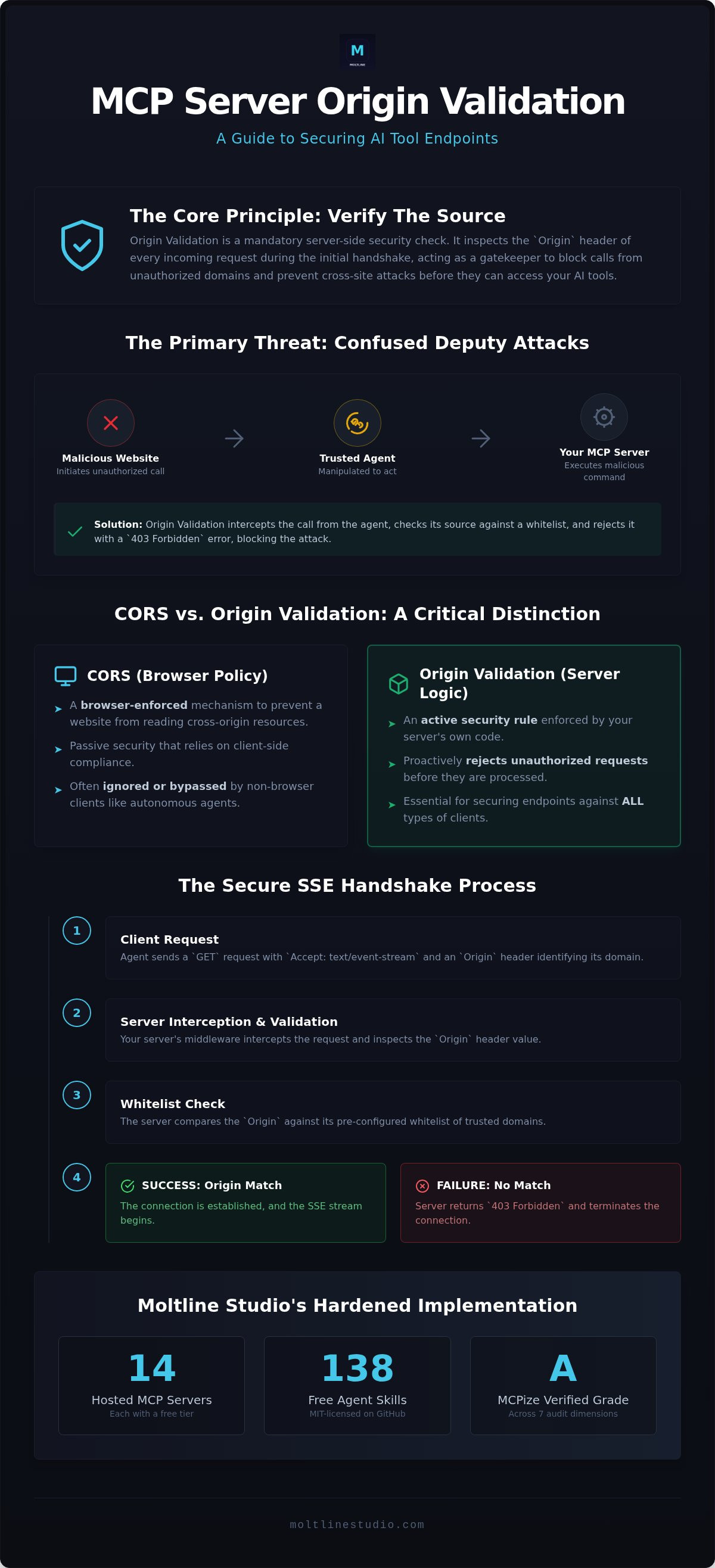
Origin validation is the mandatory process of verifying the source of an incoming HTTP or SSE request to an MCP server. It acts as a gatekeeper during the initial handshake. Before any tool execution occurs, the server inspects the request headers to ensure the calling agent or client is authorized. This mechanism is critical for remote deployments where standard input/output (stdio) transport is unavailable. Without it, your server is an open endpoint. The Model Context Protocol (MCP) documentation emphasizes this requirement for all web-based implementations.
The Confused Deputy Threat
The Confused Deputy problem occurs when an attacker manipulates a trusted agent into performing actions the user didn't intend. A malicious webpage could contain hidden instructions that trigger a local AI agent to call a file-write tool on your server. Because the agent is "trusted", the server might execute the command without checking the request's source. The Origin header serves as a technical fingerprint. It identifies the execution context. This allows the server to distinguish between a legitimate request from a verified dashboard and an unauthorized call from a third-party site. At Moltline Studio, the fourteen hosted MCP servers implement these checks to prevent cross-origin tool execution.
CORS vs Origin Validation
Many developers mistake Cross-Origin Resource Sharing (CORS) for a complete security solution. CORS is a browser-enforced policy. It prevents one site from accessing resources on another. However, many AI agents operate outside traditional browser environments. These clients often ignore CORS headers entirely. Server-side mcp server origin validation is an active security rule enforced by the server logic itself. It ensures that even if a client bypasses browser restrictions, the server rejects the request if the Origin header doesn't match the whitelist. Every server in our catalog passes the agent-readiness audit by strictly enforcing these server-side rules. Following these steps secures your 138 free agent skills against unauthorized remote calls.
- Verify the presence of the
Originheader during the GET request. - Compare the header value against a hardcoded or environment-based whitelist.
- Reject requests with a
403 Forbiddenstatus if the origin is missing or unrecognized. - Log failed attempts to identify potential scanning or brute-force activity.
SSE and HTTP Transport Security
Remote MCP servers primarily utilize Server-Sent Events (SSE) to maintain real-time model updates. This transport layer requires a persistent HTTP connection. According to IBM's guide to MCP architecture, the transport layer is responsible for the reliable delivery of messages between clients and servers. The security of this connection depends on validating the initial handshake. Validation must occur on the /sse or /mcp endpoint before the stream is established. Moltline Studio ensures all standardized protocols for SSE security are followed rigorously across its infrastructure.
SSE Handshake Requirements
The client initiates the connection with a standard GET request. It sends an Accept: text/event-stream header. This specific header triggers the mcp server origin validation logic on the backend. The server must check the Origin header against a whitelist of trusted agent domains. If the origin is unrecognized, the server should terminate the connection immediately with a 403 Forbidden status. Production environments also need to handle preflight OPTIONS requests. This ensures the browser or agent environment permits the cross-origin connection before the actual handshake begins. Since the July 2026 protocol update, servers are now stateless, making this handshake validation even more critical for scaling secure endpoints behind load balancers.
Authentication vs Validation
Origin validation is distinct from authentication. Validation confirms the request's source. Authentication confirms the user's identity. You need both. Even with an API key or the mandatory OAuth 2.1 with PKCE standard, an attacker could still exploit a "confused deputy" agent if origin checks are missing. Validation checks 'where' the request comes from while authentication checks 'who' is asking. Whitelisting provides a hard boundary against unauthorized web environments. Moltline Studio balances these requirements by providing the fourteen hosted MCP servers with pre-configured, hardened security models. Every server holds an independent MCPize Verified A grade, ensuring it meets the highest standards for production-grade stability and mcp server origin validation.
- TLS 1.3: Mandated by RFC 9852 (July 2026) for all new MCP connections to ensure transport encryption.
- OAuth 2.1: Required for authentication, utilizing PKCE to secure the authorization code grant.
- Origin Whitelisting: The primary defense against cross-site tool execution in web-based agent clients.
Configuring Origin Validation Logic
Implementing mcp server origin validation requires a dedicated middleware layer. This layer intercepts every incoming request to the /sse or /mcp endpoints before the server executes any tool logic. We recommend storing trusted origins in a structured configuration file like mcp-config.json. This allows for rapid updates without redeploying code. Every request must be scrutinized. If an incoming packet lacks a valid Origin or Host header, the server must immediately return a 403 Forbidden status. Logging these validation failures is a mandatory practice. It helps security teams identify adversarial probes or misconfigured agent environments before they escalate into breaches.
Verifying the Origin Header
The Origin header is the primary identifier for cross-site request sources. During the handshake, your server must compare the incoming header value against an array of permitted agent URLs. While wildcards might seem convenient for public tools, they introduce significant risk by allowing any domain to call your tools. Only use them if the tool carries no sensitive data. For production-grade security, explicitly list every authorized domain. This strict whitelisting is a core component of the agent-readiness audit conducted on all our infrastructure. This logic protects the 138 free agent skills from being called by unauthorized scripts.
Host and X-Forwarded-Host
Host header validation prevents DNS rebinding attacks. This is vital for local servers that could be tricked into executing commands by a malicious browser script. If your server sits behind a reverse proxy, you must parse the X-Forwarded-Host header. This ensures the request was intended for your specific endpoint rather than a spoofed destination. Correctly configuring these headers ensures the integrity of the mcp server origin validation process and the standardized protocols used for agent communication. For those who prefer pre-configured security, you can deploy any of the fourteen hosted MCP servers which include these logic layers by default.
- Origin Check: Compare against a hardcoded or environment-stored whitelist.
- Host Check: Verify the Host header matches the server's assigned domain.
- X-Forwarded-Host: Parse and validate if behind a load balancer or proxy.
- SSL Termination: Confirm TLS 1.3 is active to protect header data in transit.
- Error Codes: Ensure 403 Forbidden is returned for all validation failures.
Moltline Studio Governance Model
Moltline Studio provides a managed environment where security isn't an optional configuration. the fourteen hosted MCP servers in our catalog utilize hardened mcp server origin validation by default. This infrastructure-level enforcement ensures that developers don't have to manually manage header whitelists or security patches for every new deployment. By centralizing governance, we eliminate the risk of configuration drift that often plagues self-hosted AI tools. Our servers are pre-configured to meet the July 2026 stateless protocol requirements, ensuring they scale reliably behind modern load balancers.
MCPize Verified A Grade Audits
Every server platform we host undergoes the agent-readiness audit to maintain an independent MCPize Verified A grade. These audits cover seven distinct dimensions, including origin validation, transport layer security, and resistance to prompt injection attacks. Standardized security grades are essential for any production-ready model context protocol server implementation. These rigorous tests provide a baseline of reliability for the 138 free agent skills we've released under the MIT license. This verification ensures that your agents connect only to verified, secure endpoints that have passed professional engineering scrutiny.
Managed Server Governance
Managed hosting removes the significant burden of manual header configuration and ongoing security maintenance. Our platform handles the complexities of SSL termination and mcp server origin validation logic automatically. This prevents the Confused Deputy vulnerabilities discussed in earlier sections without requiring custom middleware development. For autonomous agents, we've integrated the x402 payment challenge to facilitate secure machine-to-machine transactions. You can access the free tier for any server without an account, API key, or credit card. This allows for immediate testing in a hardened environment. For professional operators requiring premium tools, the All-Access license is available for $19/month, with payments accepted via card or crypto. This licensing model provides a stable path for scaling AI infrastructure without the overhead of self-hosting.
- Origin Integrity: Strict whitelisting of authorized agent domains during the SSE handshake.
- Transport Layer: Mandatory TLS 1.3 for all connections to protect header data in transit.
- Injection Resistance: Validated defenses against malicious prompt manipulation within tool calls.
- Stateless Scaling: Full compliance with the July 2026 protocol updates for high-availability environments.
- Payment Integrity: Native integration with the x402 challenge for agent-led commerce and tool usage.
Secure Your Production AI Infrastructure
Securing remote tool access is a non-negotiable requirement for professional AI deployments. Implementing strict mcp server origin validation moves your infrastructure beyond simple local scripts and into a hardened, production-ready state. By verifying every SSE handshake against a trusted whitelist, you effectively neutralize the Confused Deputy threat. This ensures that your agents only execute commands from authorized sources, protecting sensitive data and system integrity. It's a critical layer for any server exposed to the public internet.
Moltline Studio handles these complexities by default across its hosting environment. Every server in our catalog holds an independent MCPize Verified A grade, confirming compliance with the July 2026 stateless protocol standards. This infrastructure supports our 138 free MIT-licensed agent skills and integrates the x402 payment challenge for autonomous agent operations. You can bypass the overhead of manual header configuration and security patching by utilizing our pre-hardened endpoints. Professional operators can access fourteen secured MCP servers with an All-Access License for $19/month. Build your next AI application on a foundation of verified security and stable engineering.
Frequently Asked Questions
How does origin validation stop CSRF attacks in MCP?
Origin validation stops CSRF attacks by forcing the server to verify the source domain of an incoming request. During the SSE handshake, the server compares the Origin header against a whitelist of trusted AI clients. If a malicious website attempts to trigger a tool call through the user's browser, the browser attaches that site's origin. The server rejects the request with a 403 Forbidden status. This process is the primary defense for mcp server origin validation in web environments.
What is the MCPize Verified A grade for servers?
This grade isn't just a label; it's an independent security benchmark assessing seven distinct audit dimensions. These include transport encryption, origin integrity, and resistance to prompt injection. Every one of the fourteen hosted MCP servers at Moltline Studio holds this grade to ensure production-grade stability. It provides a standardized way for developers to verify that a server platform is hardened against common vulnerabilities. This certification confirms the infrastructure meets the requirements for professional AI agent deployments.
Can I use origin validation with stdio transport?
Origin validation isn't applicable to stdio transport because it relies on HTTP headers. Stdio transport uses local process communication where the Origin header does not exist. Security for local tools is managed through OS-level permissions and process isolation. You only need to implement these checks when exposing tools via SSE or HTTP. Remote servers require this extra layer to distinguish between legitimate AI agents and unauthorized web-based scripts trying to proxy requests.
Does Moltline Studio support OAuth 2.1 for MCP?
Moltline Studio supports the OAuth 2.1 standard, including mandatory PKCE for all authorization grants. Our infrastructure follows the March 2025 policy requiring these protocols for all HTTP-based tool connections. This authentication layer works with TLS 1.3 to ensure data integrity and user verification. These security measures protect the 138 free agent skills accessible through our platform. Operators can scale their agents confidently knowing their servers don't require manual patching to meet the July 2026 stateless requirements.
What happens if an MCP request has no Origin header?
If an incoming request doesn't have an Origin header, the server should immediately return a 403 Forbidden response. Browser-based clients are required to include this header for cross-origin requests. Its absence typically suggests a non-standard client or a manual probe attempting to bypass security filters. Dropping these requests is a core requirement for mcp server origin validation logic. It prevents anonymous or unidentified sources from interacting with your tools, maintaining a strict boundary between trusted and untrusted traffic.
Implement these validation rules to secure your production endpoints. For a pre-hardened environment, access fourteen secured MCP servers with an All-Access License and start deploying tools with confidence.


