
Implementing mcp sse transport for remote AI agents requires establishing a persistent text/event-stream connection via the EventSource API. This method replaces standard stdio pipes, allowing servers to push real-time context updates while clients send commands via separate POST requests. It ensures low-latency communication by maintaining an open HTTP connection, effectively preventing timeouts during long-running autonomous tasks.
Why do production AI agents frequently fail during long-running tasks when using standard stdio connections? You've likely dealt with connection timeouts and the frustration of debugging broken streams in a remote environment. This guide provides a technical breakdown for deploying a functional remote MCP server while securing the transport layer against unauthorized access. We'll examine the specific message flow, authentication headers, and the MCPize Verified A grade standards used across the fourteen hosted MCP servers. Secure transport. Persistent context. Zero polling overhead. By utilizing the 138 free agent skills as a baseline, you can verify your transport reliability before moving to a production All-Access license. We focus on concrete implementation details over abstract concepts to ensure your agents remain stable under adversarial conditions.
Key Takeaways
- Establish asynchronous communication by combining a unidirectional text/event-stream with standard POST requests for client-to-server messaging.
- Configure mcp sse transport endpoints to maintain persistent connections, effectively eliminating the timeouts common in long-running autonomous agent tasks.
- Secure remote servers by validating request origins and integrating the x402 payment challenge for agents requiring premium tool access.
- Scale deployments using load balancers that support sticky sessions to maintain the integrity of long-lived HTTP streams.
- Verify server reliability against the MCPize Verified A grade standard to ensure readiness for production-level adversarial conditions.
Understanding MCP SSE Transport Mechanisms
The mcp sse transport functions as the primary bridge for remote AI agents. Unlike local stdio pipes, this protocol uses Server-Sent Events (SSE) to maintain a persistent, open-ended HTTP connection. It enables a server to push context updates, tool results, and status logs to an agent client without requiring the client to poll for data. This architecture is critical for builders who need to scale beyond a single machine. It provides a stable foundation for remote context delivery using the 138 free agent skills available on GitHub.
Server Sent Events vs Stdio Transport
Stdio transport relies on standard input and output streams. It works well for local processes where the client executes the server as a child process. Stdio cannot traverse network boundaries. Remote hosting requires a network-aware protocol. SSE enables hosting on port 443. This makes it compatible with standard firewalls and load balancers. While stdio offers near-zero latency, SSE introduces minimal network overhead while providing multi-tenant access. This is the standard used for the fourteen hosted MCP servers. It ensures that agents can access tools regardless of their deployment location.
The Two Channel Architecture
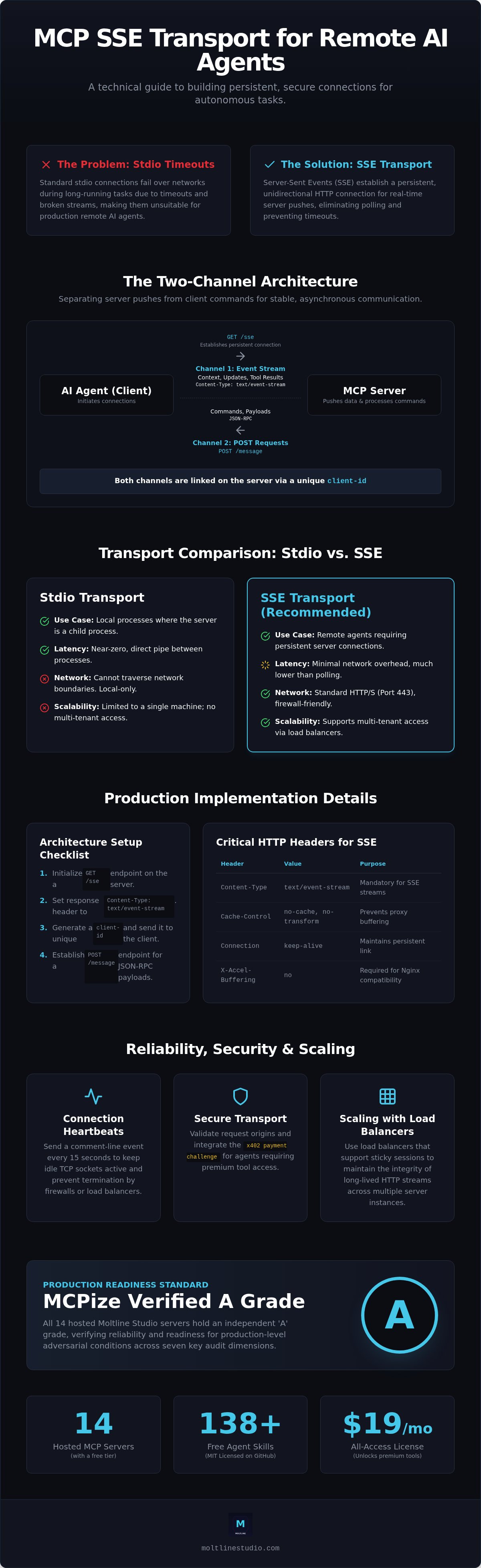
This transport method operates through two distinct channels. First, the client initiates a GET request to the server's SSE endpoint. The server responds with a text/event-stream header and keeps the connection alive. This channel is strictly unidirectional. Data only flows from the server to the client. To send messages back, the client uses a separate POST endpoint. Every JSON-RPC request is sent as a standard HTTP POST payload. A unique client-id maps these two channels together on the server side. This separation simplifies implementation. It avoids the complex handshake and frame management required by WebSockets. You get the benefits of a persistent stream using standard HTTP verbs.
- Initialize a GET /sse endpoint on the server.
- Set the response header to
Content-Type: text/event-stream. - Generate a unique
client-idand send it to the client. - Establish a POST /message endpoint to receive JSON-RPC payloads.
Implementing MCP SSE Transport in Production
Production mcp sse transport environments demand more than just open ports. You must manage state across two distinct HTTP channels while preventing memory leaks from abandoned streams. Implementing the EventSource API correctly on the client side is only half the battle. The server must handle asynchronous JSON-RPC payloads while maintaining a stable event-stream. This setup is the architecture used by the fourteen hosted MCP servers to ensure high availability for remote agents.
Endpoint Configuration and Routing
Your server logic must distinguish between the stream initialization and message delivery. The GET /sse route establishes the long-lived connection. The POST /message route receives actual agent commands. Use the following headers to maintain compliance with the protocol standards and prevent intermediary proxies from buffering your data.
| Header | Value | Purpose |
|---|---|---|
| Content-Type | text/event-stream | Mandatory for SSE streams |
| Cache-Control | no-cache, no-transform | Prevents proxy buffering |
| Connection | keep-alive | Maintains persistent link |
| X-Accel-Buffering | no | Required for Nginx compatibility |
Session management relies on a unique client identifier. When a client connects to /sse, the server generates a UUID. This ID must be included in the initial event. All subsequent POST requests to the /message endpoint must include this ID. This allows the server to route responses back to the correct stream. Failure to map these correctly results in context fragmentation, where an agent receives tool outputs intended for a different session.
Connection Lifecycle and Heartbeats
Idle connections are frequently terminated by firewalls or load balancers. To prevent this, implement a 15-second heartbeat. The server should emit a comment-line event periodically to keep the TCP socket active. If a client disconnects, the server must immediately clear the associated agent context to prevent memory leaks. This is a core requirement for any tool seeking an MCPize Verified A grade audit result.
Server-side event emission should follow this structure to ensure the agent client parses the data correctly:
res.write('event: message\n');

res.write('data: ' + JSON.stringify(jsonRpcPayload) + '\n\n');
Client-side reconnection logic should use exponential backoff. Don't simply hammer the server with immediate retries. This approach maintains stability during brief network flickers without overstressing the host. For developers who prefer to skip this manual configuration, utilizing pre-configured MCP servers provides a tested baseline for production workloads.
Security and Authentication for SSE Connections
Exposing a server via mcp sse transport without a hardened security layer invites unauthorized tool execution. While the protocol handles message delivery, it doesn't natively enforce authentication. You must implement these safeguards at the application level. Every server in the fourteen hosted MCP servers adheres to these rigorous standards to prevent context injection and data leaks. Protecting context is a matter of functional integrity. It requires a disciplined approach to endpoint exposure.
Origin Validation and CORS Policies
Unrestricted endpoints are vulnerable to cross-site request forgery and hijacking variants. Set your Access-Control-Allow-Origin header to specific AI client domains rather than a wildcard. The POST /message endpoint requires strict validation to ensure payloads originate from the same session as the SSE stream. Audit your configuration against the agent-readiness audit benchmarks to confirm your environment is hardened for production. Don't leave your endpoints open to adversarial discovery.
Implementing x402 Payment Protocols
Autonomous agents require a programmatic way to handle premium tool access without human intervention. The x402 payment challenge solves this by allowing agents to verify their status via a 402 Required response. This protocol integrates with the All-Access license infrastructure, which costs $19/month. Agents prove authorization using license keys purchased via card or cryptocurrency. This ensures that mcp sse transport remains secure even when tools are accessed by non-human operators. It's a methodical way to manage resource access.
- Enforce TLS 1.3 for all endpoints to protect sensitive JSON-RPC data.
- Disable wildcard CORS on the
/messageroute to prevent hijacking. - Implement token-based session validation to map clients to specific streams.
- Integrate the x402 challenge for agents requiring premium tool access.
- Verify configurations against the MCPize Verified A grade standards.
A stable security posture is non-negotiable for production deployments. If your server fails the agent-readiness audit, it isn't ready for public exposure. You can deploy with confidence by using the fourteen hosted MCP servers, which are pre-audited for professional environments.
Scaling Remote MCP Server Architectures
Scaling mcp sse transport requires a departure from stateless REST API patterns. Standard round-robin load balancing breaks these connections by routing POST messages to servers that don't hold the active GET stream. You must implement sticky sessions at the load balancer level to ensure the client-id remains mapped to the correct server instance. Decoupling your JSON-RPC message processor from the SSE emission logic allows the processing layer to scale horizontally while the SSE gateway maintains the persistent socket. This architecture is essential for maintaining the MCPize Verified A grade standards across high-traffic environments.
Managing Multi-Tenant Agent Sessions
Isolating context data between different license holders prevents data leakage in multi-tenant environments. Use a shared state store like Redis to maintain session mappings across scaled instances. This ensures that an agent can recover its context if a specific gateway node fails. Detailed session management logic and implementation patterns are available on the protocols page. Every session must be independently audited to ensure it meets the performance and security benchmarks required for professional deployment.
Transitioning to Managed Infrastructure
Self-hosting persistent connections introduces significant engineering overhead regarding uptime monitoring and security patching. Utilizing the fourteen hosted MCP servers removes the burden of managing these complex transport lifecycles. You can deploy the 138 free agent skills as standardized playbooks to accelerate your agent's capabilities without building the backend from scratch. Managed infrastructure provides the stability needed for critical agentic workflows. It ensures your tools remain responsive even under adversarial conditions or sudden traffic spikes.
Frequently Asked Questions
What is the maximum number of SSE connections per server?
Connection limits depend on server memory and available file descriptors in the host operating system. Modern Linux environments can support thousands of concurrent streams when properly tuned for high-concurrency workloads. You should monitor resource usage to prevent latency degradation during peak traffic.
How do I handle SSE reconnection in a load-balanced environment?
Implement sticky sessions at the load balancer level to ensure routing consistency for every client. This keeps the GET stream and subsequent POST messages on the same physical server instance. Without session affinity, the agent context will become fragmented and the transport will fail.
Does mcp sse transport support binary data?
The protocol is strictly text-based and utilizes UTF-8 encoding for all transmissions. Any binary payloads must be encoded into Base64 before being sent through the event stream to ensure compatibility. This maintains compliance with standard browser and agent client specifications.
How do I secure the POST endpoint for message delivery?
Enforce strict origin validation and verify that the client-id exists in the active session pool before processing any data. You should also utilize TLS 1.3 to encrypt all JSON-RPC data in transit. This prevents unauthorized users from injecting commands into an active agent session.
What is the cost of managed MCP hosting?
Managed hosting for premium tools is available via the All-Access license for $19/month. There are also 14 hosted MCP servers available for free use with no account or registration required. Payments for premium features can be made via card or cryptocurrency protocols.
Choose a server from the fourteen hosted MCP servers to begin testing your remote agent's transport reliability.
Deploying Hardened Remote Context Systems
Deploying mcp sse transport moves your AI agents from local scripts to production-ready remote systems. Success depends on managing the two-channel architecture and enforcing strict origin validation. This setup prevents connection timeouts while ensuring sensitive context data remains isolated between tenants. Maintaining this infrastructure manually requires constant auditing against evolving security standards and load balancing requirements. You can bypass the engineering overhead of manual socket management by utilizing pre-configured environments.
Every server we host meets the MCPize Verified A grade standard across seven audit dimensions. This includes native support for the x402 payment challenge for autonomous agents and access to 138 MIT-licensed SKILL.md playbooks for rapid skill deployment. These tools are built for adversarial conditions where functional integrity is the only metric that matters. Professional builders prioritize stability and predictable outcomes over experimental configurations. You can focus on agent logic while the transport layer handles the complexities of persistent context delivery.
Access the fourteen hosted MCP servers and 138 free agent skills to start building your remote agent infrastructure today. Your agents are ready for the next level of autonomy.
Frequently Asked Questions
What is the primary difference between stdio and SSE for MCP?
Stdio transport is restricted to local process communication where the client and server reside on the same machine. In contrast, mcp sse transport enables remote communication over standard HTTP/S. Stdio uses standard input and output pipes for bidirectional data. SSE utilizes a persistent GET stream for server-to-client updates paired with separate POST requests for client-to-server messages. This makes SSE the necessary choice for cloud-hosted agents and multi-tenant environments.
How do I handle authentication for a remote MCP server?
Authentication is managed at the application layer because the protocol is transport-agnostic. You should implement Bearer tokens or API keys within the HTTP headers of the initial GET request and all subsequent POST messages. For autonomous agents, the x402 payment challenge provides a programmatic way to verify access for premium tools. Always enforce TLS 1.3 to prevent credential interception and ensure your configuration passes the agent-readiness audit standards before public exposure.
Can I use the MCP SSE transport with Claude Desktop?
Yes, Claude Desktop supports SSE transport by configuring the mcpServers JSON file with the remote URL and transport type. You must specify the remote endpoint instead of a local command path. This allows the desktop client to connect to any of the fourteen hosted MCP servers without local installation. Ensure your network permits long-lived HTTP connections to avoid stream interruptions during complex tasks. It's a reliable way to access remote tools directly from your desktop.
What are the common causes of MCP SSE connection timeouts?
Timeouts usually occur due to aggressive idle-connection reaping by load balancers or firewalls. If the server doesn't emit a heartbeat event every 15 seconds, the intermediary proxy may close the socket. Another cause is the browser's maximum concurrent connection limit per domain, which can block new mcp sse transport streams if too many are already open. Implementing a methodical heartbeat and using sticky sessions helps maintain connection stability in professional production environments.
Is the x402 payment protocol required for all MCP servers?
The x402 protocol is only required for servers providing premium tools or those requiring autonomous payment verification. Free tier tools, such as the fourteen hosted MCP servers at Moltline Studio, don't require an account or payment protocol for basic access. The challenge is specifically designed for agents using the All-Access license to programmatically verify advanced capabilities. It ensures that non-human operators can settle access fees via card or crypto without human oversight or manual intervention.
Review the technical specifications for the fourteen hosted MCP servers to begin your remote deployment.


